Friday, November 30, 2007

St. Andrew

St. Andrew and St. Francis

St. Andrew and St. Francis

View on the wall


``Where the Bishop is, there let the multitude of believers be;
even as where Jesus is, there is the Catholic Church'' Ignatius of Antioch, 1st c. A.D


Christmas Novena I


Some Catholics pray this Novena from 30 November to 24 December. Others prefer the more classic 9-day Christmas Novena begun on 16 December. And, of course, some Catholics pray no Christmas Novena at all.

Christmas Novena I
Say 15 times a day from St. Andrew's Day (30 November) until Christmas

Hail, and blessed be the hour and moment at which the Son of God was born of a most pure Virgin at a stable at midnight in Bethlehem in the piercing cold. At that hour vouchsafe, I beseech Thee, to hear my prayers and grant my desires. (Mention your intentions here) Through Jesus Christ and His most Blessed Mother.

Back to Customs of the Liturgical Year
Back to Being Catholic
Index


The Golden Legend
The Life of Saint Andrew

After the feasts of our Lord Jesu Christ tofore set in order follow the legends of Saints, and first of Saint Andrew.

Andrew is expounded, and is as much as to say as fair, or answering unto strength, and it is said of andor, that is as much to say as strength; or Andrew is said thus, as antipos of ana, which is to say high, and of tropos which is conversion, so that Andrew is to say, a man highly converted, and in heaven addressed unto his maker. He was fair in his life, answering in wisdom and in doctrine, strong in pain and converted high in glory. The priests and deacons of Achaia wrote his passion like as they had seen it with their eyes.

Andrew and some other disciples were called three times of our Lord. He called them first in the knowledging of him, as when Saint Andrew was with John the Baptist, his master, and another disciple; he heard that John said: Lo! here the Lamb of God; and then he went anon with another disciple, and came to Jesu Christ and abode with him all that day. And then Saint Andrew found Simon, his brother, and brought him to Jesu Christ, and the next day following they went to their craft of fishing. And after this he called them the second time by the stagne of Gennesereth, which is named the sea of Galilee. He entered into the ship of Simon and of Andrew, and there was taken great multitude of fish, and he called James and John, which were in another ship, and they followed him, and after went into their proper places.

After this he called them from their fishing, and said: Come, follow me, I shall make you fishers of men. Then they left their ships and nets, and followed him, and after this they abode with him, and went no more to their own houses. And howbeit he called Andrew and some other to be apostles, of which calling, Matthew saith in the third chapter: He called to him them that he would. And after the ascension of our Lord, the apostles were departed, and Andrew preached in Scythia and Matthew in Murgondy. And the men of this country refused utterly the preaching of Saint Matthew, and drew out his eyes, and cast him in prison fast bounden. In the meanwhile an angel, sent from our Lord, and commanded him to go to Saint Matthew into Murgondy, and he answered that he knew not the way. And then the angel commanded him that he should go unto the seaside, and that be should enter into the first ship that he should find, and so he did gladly, in accomplishing the commandment, and went into the city by the leading of the angel, and had wind propitious. And when he was come he found the prison open, where Saint Matthew was in; and when he saw him he wept sore and worshipped him; and then our Lord rendered and gave again to Saint Matthew his two eyes and his sight. And then Saint Matthew departed from thence and came into Antioch, and Saint Andrew abode in Murgondy, and they of the country were wroth that Saint Matthew was so escaped. Then took they Saint Andrew and drew him through the places, his hands bounden in such wise that the blood ran out. He prayed for them to Jesu Christ, and converted them by his prayer; and from thence he came to Antioch. This that is said of the blinding of Saint Matthew, I suppose that it is not true, nor that the evangelist was not so infirm, but that he might get for his sight that Saint Andrew gat for him so lightly.

It was so that a young man came and followed Saint Andrew, against the will of all his parents; and on a time his parents set fire on the house where he was with the apostle, and when the flame surmounted right high, the child took a brush full of water and sprinkled withal the fire, and anon the fire quenched. And then his friends and parents said: Our son is made an enchanter. And as they would have gone up by the ladders, they were suddenly made blind, that they saw not the ladders, and then one of them recried and said: Wherefore enforce ye you against them? God fighteth for them and ye see it not. Cease ye and leave off, lest the ire of our Lord fall on you. Then many of them that saw this believed in our Lord, and the parents died within forty days after, and were put in one sepulchre.

There was a woman with child, joined in wedlock with a homicide who was troubled greatly upon her deliverance; and at the time of childing she might not be delivered. She bade her sister to go to Diana and pray to her that she help me. She went and prayed, and Diana said to her, which was the devil in an idol: Wherefore prayest thou to me? I may not help ne profit thee, but go unto Andrew the apostle which may help thee and thy sister. And she went to him, and brought him to her sister, which travailed in great pain, and began to perish. And the apostle said to her: By good right thou sufferest this pain; thou conceivedst in treachery and sin, and thou counselledst with the devil. Repent thee, and believe in Jesu Christ, and thou shalt be anon delivered of thy child. And when she believed and was repentant, she was delivered of her child, and the pain and sorrow passed and ceased.

An old man called Nicholas by name, went unto the apostle and said to him: Sir, I have lived fifty years, and always in lechery. And I took on a time a gospel, in praying God that he would give me from then forthon continence. But I am accustomed in this sin, and full of evil delectation, in such wise that I shall return to this sin accustomed. On a time that I was inflamed by luxury, I went to the bordel, and forgat the gospel upon me, and anon the foul woman said: Go hence thou old man, for thou art an angel of God, touch me not, nor come not near me, for I see marvel upon thee. And I was abashed of the word of the woman, and I remembered that I had the gospel upon me, wherefore I beseech thee to pray God for me and for my health. And when Saint Andrew heard this he began to weep, and prayed from tierce unto nones. And when he arose he would not eat, and said: I shall eat no meat till I know whether our Lord shall have pity of this old man. And when he had fasted five days, a voice came to Saint Andrew and said to him: Andrew, thy request is granted for the old man, for like as thou hast fasted and made thyself lean, so shall he fast and make himself lean by fastings for to be saved. And so he did, for he fasted six months to bread and water. and after that he rested in peace and good works. Then came a voice that said: I have gotten Nicholas by thy prayers whom I had lost.

A young christian man said to Saint Andrew: My mother saw that I was fair, and required me for to have to do sin with her; and when I would not consent to her in no manner, she went to the judge, and would return and lay to me the sin of so great a felony. Pray for me that I die not so untruly; for when I shall be accused I shall hold my peace and speak not one word, and have liefer to die than to defame and slander my mother so foully. Thus came he to judgment, and his mother accused him, saying that he would have defouled her. And it was asked of him oft if it was so as she said, and he answered nothing. Then said Saint Andrew to her: Thou art most cruel of all women, which for the accomplishment of thy lechery wilt make thy son to die. Then said this woman to the provost: Sir, sith that my son came, and accompanied with this man, he would have done his will with me, but I withstood him that he might not. And anon the provost and judge commanded that the son should be put in a sack anointed with glue, and thrown into the river, and Saint Andrew to be put in prison till he had advised him how he might torment him. But Saint Andrew made his prayer to God, and anon came an horrible thunder, which feared them all, and made the earth to tremble strongly and the woman was smitten with the thunder unto the death. And the other prayed the apostle that they might not perish, and he prayed for them, and the tempest ceased. Thus then the provost believed in God, and all his meiny.

After this, as the apostle was in the city of Nice, the citizens said to him that there were seven devils without the city, by the highway, which slew all them that passed forthby. And the apostle Andrew commanded them to come to him, which came in the likeness of dogs, and sith he commanded them that they should go whereas they should not grieve ne do harm to any man; and anon they vanished away. And when the people saw this they received the faith of Jesu Christ. And when the apostle came to the gate of another city there was brought out a young man dead. The apostle demanded what was befallen him, and it was told him that seven dogs came and strangled him. Then the apostle wept and said: O Lord God, I know well that these were the devils that I put out of Nice; and after said to the father of him that was dead: What wilt thou give to me if I raise him? And he said: I have nothing so dear as him, I shall give him to thee. And anon the apostle made his prayers unto almighty God, and raised him from death to life, and he went and followed him.

On a time there were forty men by number, which were coming by the sea, sailing unto the apostle, for to receive of him the doctrine of the faith. And the devil raised and moved a great storm and so horrible a torment that all they were drowned together. And when their bodies were brought tofore the apostle, he raised them from death to life anon, and there they said all that was befallen to them. And therefore it is read in an hymn that he rendered the life to young men drowned in the sea. And the blessed Saint Andrew, whilst he was in Achaia, he replenished all the country with churches and converted the people to the faith of Jesu Christ and informed the wife of AEgeas, which was provost and judge of the town, in the faith, and baptized her. And when AEgeas heard this he came into the city of Patras and constrained the christians to sacrifice. And Saint Andrew came unto him, and said: It behoveth thee which hast deserved to be a judge, to know thy judge which is in heaven, and he so known, to worship him, and so worshipping, withdraw thy courage from the false gods. And AEgeas said: Thou art Andrew that preachest a false law, which the princes of Rome have commanded to be destroyed. To whom Andrew said: The princes of Rome knew never how the son of God came and taught and informed them that the idols be devils, and he that teacheth such things angereth God, and he, so angered, departeth from them that he heareth them not, and therefore be they caitiffs of the devil and be so illused and deceived that they issue out of the body all naked, and bear nothing with them but sins.

And AEgeas said to him: These be the vanities that your Jesus preached, which was nailed on the gallows of the cross. To whom Andrew said: He received with his agreement the gibbet of the cross, not for his culp and trespass, but for our redemption. And AEgeas said: When he was delivered of his disciple, taken and holden with the Jews, and crucified by the knyghts, how sayst thou that it was by his agreement? Then Saint Andrew began to show by five reasons that Jesu Christ received death by his own agreement and will, forasmuch as he came tofore his passion, and said to his disciples that it should be, when he said: We shall go up to Jerusalem, and the son of the maid shall be betrayed. And also for that Peter would withdraw him, he reproved him, and said: Go after me, Sathanas. And also for that he showed that he had power to suffer death, and to rise again when he said: I have power to put away my soul and to take it again. And also for that he knew tofore him that betrayed him, when he gave him his supper, and showed him not. And also for that he chose the place where he should be taken, for he knew well that the traitor should come. And Saint Andrew said that he had been at all these things, and yet he said more, that the mystery of the cross was great. To whom AEgeas said: It may not be said mystery, but torment, and if thou wilt not grant to my sayings, truly I shall make thee prove this mystery. And Andrew said to him: If I doubted the gibbet of the cross I would not preach the glory thereof. I will that thou hear the mystery, and if thou knew and believedst on it thou shouldst be saved. Then he showed to him the mystery of the cross, and assigned five reasons. The first is this: Forasmuch as the first man that deserved death was because of the tree, in breaking the commandment of God, then is it thing convenable that the second man should put away that death, in suffering the same on the tree. The second was that, he that was made of earth not corrupted, and was breaker of the commandment, then was it thing convenable that he that should repel this default, should be born of a virgin. The third; for so much as Adam had stretched his hand disordinately to the fruit forbidden, it was thing convenable that the new Adam should stretch his hands on the cross. The fourth; for so much as Adam had tasted sweetly the fruit forbidden, it is therefore reason that it be put away by thing contrary; so that Jesu Christ was fed with bitter gall. The fifth; for as much as Jesu Christ gave to us his immortality, it is thing reasonable, that he take our mortality. For if Jesu Christ had not been dead, man had never been made immortal. And then said AEgeas: Tell to thy disciples such vanities, and obey thou to me, and make sacrifice unto the Gods almighty. And then said Saint Andrew: I offer every day unto God Almighty, a lamb without spot, and after that he is received of all the people, so liveth he and is all whole. Then demanded AEgeas how that might be. And Andrew said: Take the form for to be a disciple, and thou shalt know it well. I shall demand thee, said AEgeas, by torments. Then he being all angry, commanded that he should be enclosed in prison, and on the morn he came to judgment, and the blessed Saint Andrew unto the sacrifice of the idols. And AEgeas commanded to be said to him: If thou obey not to me, I shall do hang thee on the cross, for so much as thou hast praised it. And thus as he menaced him of many torments Saint Andrew said to him: Think what torment that is most grievous that thou mayst do to me, and the more I suffer, the more I shall be agreeable to my king, because I shall be most firm in the torments and pain. Then commanded AEgeas that he should be beaten of twenty-one men, and that he should be so beaten, bounden by the feet and hands unto the cross, to the end that his pain should endure the longer. And when he was led unto the cross, there ran much people thit And when he saw the cross from far he saluted it, and said: All hail cross which art dedicate in the body of Jesu Christ, and wert adorned with the members of him, as of precious stones. Tofore that our Lord ascended on thee, thou wert the power earthly, now thou art the love of heaven; thou shalt receive me by my desire. I come to thee surely and gladly so that thou receive me gladly as disciple of him that hung on thee. For I have alway worshipped thee and have desired thee to embrace. O thou cross which hast received beauty and noblesse of the members of our Lord, whom I have so long desired and curiously loved, and whom my courage hath so much desired and coveted, take me from hence, and yield me to my master, to the end that he may receive me by thee. And in thus saying, he despoiled and unclad him, and gave his clothes unto the butchers. And then they hung him on the cross, like as to them was commanded. And there he lived two days, and preached to twenty thousand men that were there. Then all the company swore the death of AEgeas, and said: The holy man and debonair ought not to suffer this. Then came thither AEgeas for to take him down off the cross. And when Andrew saw him he said: Wherefore art thou come to me, AEgeas? If it be for penance thou shalt have it, and if it be for to take me down, know thou for certain thou shalt not take me hereof alive; for I see now my lord and king that abideth for me. Therewith they would have unbound him, and they might in nowise touch him for their arms were bynomen and of no power. And when the holy Saint Andrew saw that the world would have taken him down off the cross he made this orison hanging on the cross, as Saint Austin saith in the book of penance: Sire, suffer me not to descend from this cross alive, for it is time that thou command my body to the earth, for I have born long the charge, and have so much watched upon that which was commanded to me, and have so long travailed, that I would now be delivered of this obedience, and be taken away from this agreeable charge. I remember that it is much grievous, in proud bearing, in doubting, unsteadfast in nourishing, and have gladly laboured in the refraining of them. Sire, thou knowest how oft the world hath entended to withdraw me from the purity of contemplation, how oft he hath entended to awake me from the sleep of my sweet rest, how much and how oft times he hath made me to sorrow, and as much as I have had might I have resisted it right debonairly in fighting against it, and have by thy work and aid surmounted it: and I require of thee just and debonair guerdon and reward, and that thou command that I go not again thereto, but I yield to thee that which thou hast delivered me. Command it to another and empesh me no more, but keep me in the resurrection, so that I may receive the merit of my labour. Command my body unto the earth, so that it behoveth no more to wake, but let it be stretched freely to thee, which art fountain of joy never failing. And when he had said this, there came from heaven a right great shining light, which environed him by the space of half an hour, in such wise that no man might see him. And when this light departed he yielded and rendered therewith his spirit. And Maximilla, the wife of AEgeas, took away the body of the apostle, and buried it honourably. And ere that AEgeas was come again to his house, he was ravished with a devil by the way, and died tofore them all. And it is said that out of the sepulchre of Saint Andrew cometh manna like unto meal, and oil which hath a right sweet savour and odour. And by that is shewed to the people of the country when there shall be plenty of goods. For when ther cometh but little of manna, the earth shall bring forth but little fruit, and when it cometh abundantly, the earth bringeth forth fruit plenteously. And this might well happen of old time, for the body of him was transported into Constantinople.

There was a bishop that led an holy and religious life, and loved Saint Andrew by great devotion, and worshipped him above all other saints, so that in all his works he remembered him every day, and said certain prayers in the honour of God and Saint Andrew, in such wise that the enemy had envy on him, and set him for to deceive him with all his malice, and transformed him into the form of a right fair woman, and came to the palace of the bishop, and said that she would be confessed to him. And the bishop bade her to go confess her to his penitencer, which had plain power of him. And she sent him word again that she would not reveal nor show the secrets of her confession to none but to him, and so the bishop commanded her to come; and she said to him: Sir, I pray thee that thou have mercy on me; I am so as ye see in the years of my youth, and a maid, and was deliciously nourished from my infancy, and born of royal lineage, but I am come alone, in a strange habit; for my father which is a right mighty king would give me to a prince by marriage; whereto I answer that I have horror of all beds of marriage, and I have given my virginity to Jesu Christ for ever, and therefore I may not consent to carnal copulation. And in the end he constrained me so much that I must consent to his will or suffer divers torments; so that I am fled secretly away, and had liefer be in exile, than to break and corrupt my faith to my spouse. And because I hear the praising of your right holy life, I am fled unto you and to your guard, in hope that I may find with you place of rest, whereas I may be secret in contemplation, and eschew the evil perils of this present life, and flee the diverse tribulations of the world. Of which thing the bishop marvelled him greatly, as well for the great noblesse of her lineage, as for the beauty of her body, for the burning of the great love of God, and for the honest fair speaking of this woman. So that the bishop answered to her, with a meek and pleasant voice: Daughter, be sure and doubt nothing; for he for whose love thou hast despised thyself and these things, shall give to thee the great thing. In this time present is little glory or joy, but it shall be in time to come. And I which am sergeant of the same, offer me to thee, and my goods; and choose thee an house where it shall please thee, and I will that thou dine with me this day. And she answered and said: Father, require of me no such thing, for by adventure some evil suspicion might come thereof. And also the resplendour of your good renomee might be thereby impaired. To whom the bishop answered: We shall be many together, and I shall not be with you alone, and therefore there may be no suspicion of evil. Then they came to the table, and were set, that one against that other, and the other folk here and there, and the bishop entendeth much to her, and beheld her alway in the visage, and he marvelled of her great beauty. And thus as he fixed his eyes on her his courage was hurt, and the ancient enemy, when he saw the heart of him, hurt with a grievous dart. And this devil apperceived it and began to increase her beauty more and more; insomuch that the bishop was then ready for to require her to sin when he might.

Then a pilgrim came and began to smite strongly at the gate or door, and they would not open it. Then he cried and knocked more strongly; and the bishop asked of the woman if she would that the pilgrim should enter. And she said; Men should ask first of him a question, grievous enough, and if he could answer thereto, he should be received, and if he could not, he should abide without, and not come in, as he that were not worthy but unwitting. And all agreed to her sentence, and enquired which of them were sufficient to put the question. And when none was found sufficient, the bishop said: None of us is so sufficient as ye, dame, for ye pass us all in fair speaking, and shine in wisdom more than we all; propose ye the question. Then she said: Demand ye of him, which is the greatest marvel that ever God made in little space. And then one went and demanded the pilgrim. The pilgrim answered to the messenger that it was the diversity and excellence of the faces of men: for among all so many men as have been sith the beginning of the world unto the end, two men might not be found of whom their faces were like and semblable in all things. And when the answer was heard, all they marvelled and said that this was a very and right good answer of the question. Then the woman said: Let the second question be proposed to him, which shall be more grievous to answer to, for to prove the better the wisdom of him, which was this: Whether the earth is higher than all the heaven? And when it was demanded of him the pilgrim answered: In the heaven imperial where the body of Jesu Christ is, which is form of our flesh, he is more high than all the heaven. Of this answer they marvelled all when the messenger reported it, and praised marvellously his wisdom. Consequently she said the third question, which was more dark and grievous to assoil. For to prove the third time his wisdom, and that then he be worthy to be received at the bishop's table, demand and ask of him; How much space is from the abysm unto the same heaven. Then the messenger demanded of the pilgrim, and he answered him: Go to him that sent thee to me and ask of him this thing, for he knoweth better than I, and can better answer to it, for he hath measured this space when he fell from heaven into the abysm, and I never measured it. This is nothing a woman but it is a devil which hath taken the form of a woman. And when the messenger heard this, he was sore afraid and told tofore them all this that he had heard. And when the bishop heard this and all other, they were sore afraid. And anon forthwith, the devil vanished away tofore their eyes.

And after, the bishop came again to himself, and reproved himself bitterly, weeping, repenting and requiring pardon of his sin, and sent a messenger for to fetch and bring in the pilgrim, but he found him never after. Then the bishop assembled the people, and told to them the manner of this thing, and prayed them that they would all be in orisons and prayers, in such wise that our lord would show to some person who this pilgrim was which had delivered him from so great peril. And then it was showed that night to the bishop that it was Saint Andrew which had put him in the habit of a pilgrim for the deliverance of him. Then began the bishop more and more to have devotion and remembrance to Saint Andrew than he had tofore.

The provost of a city had taken away a field from the church of Saint Andrew, and by the prayer of the bishop he was fallen into a strong fever. And then he prayed the bishop that he would pray for him, and he would again yield the field. And when the bishop had prayed for him, and he had his health, he took the field again. Then the bishop put himself to prayer and orisons, and brake all the lamps of the church, and said: There shall none of them be lighted till that our Lord hath venged him on his enemy, and that the church have recovered that which she hath lost. And then the provost was strongly tormented with fevers, and sent to the bishop by messengers that he should pray for him, and he would yield again his field and another semblable. Then the bishop answered: I have heretofore prayed for him, and God heard and granted my prayer, and when he was whole, he took from me again the field. And then the provost made him to be borne to the bishop, and constrained him for to enter into the church for to pray. And the bishop entered into the church, and anon the provost died, and the field was re-established unto the church. Et sic est finis.

Table of Contents | Catholic Community Forum | Contact Author | Message Board

Do you have a special devotion to St. Andrew?

Tuesday, November 27, 2007

Book II Chapter 11 Imitation of Christ

The Eleventh Chapter

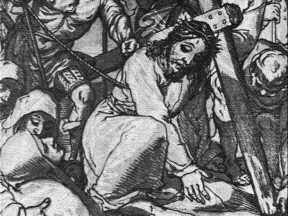
Few Love the Cross of Jesus Jesus carrying the cross


JESUS has always many who love His heavenly kingdom, but few who bear His cross.

He has many who desire consolation, but few who care for trial.

He finds many to share His table, but few to take part in His fasting.

All desire to be happy with Him; few wish to suffer anything for Him.

Many follow Him to the breaking of bread, but few to the drinking of the chalice of His passion.

Many revere His miracles; few approach the shame of the Cross.

Many love Him as long as they encounter no hardship; many praise and bless Him as long as they receive some comfort from Him.

But if Jesus hides Himself and leaves them for a while, they fall either into complaints or into deep dejection.

Those, on the contrary, who love Him for His own sake and not for any comfort of their own, bless Him in all trial and anguish of heart as well as in the bliss of consolation.

Even if He should never give them consolation, yet they would continue to praise Him and wish always to give Him thanks.

What power there is in pure love for Jesus—love that is free from all self-interest and self-love!

Do not those who always seek consolation deserve to be called mercenaries?

Do not those who always think of their own profit and gain prove that they love themselves rather than Christ?

Where can a man be found who desires to serve God for nothing?

Rarely indeed is a man so spiritual as to strip himself of all things. And who shall find a man so truly poor in spirit as to be free from every creature? His value is like that of things brought from the most distant lands.

If a man give all his wealth, it is nothing; if he do great penance, it is little; if he gain all knowledge, he is still far afield; if he have great virtue and much ardent devotion, he still lacks a great deal, and especially, the one thing that is most necessary to him. What is this one thing?

That leaving all, he forsake himself, completely renounce himself, and give up all private affections. Then, when he has done all that he knows ought to be done, let him consider it as nothing, let him make little of what may be considered great; let him in all honesty call himself an unprofitable servant.

For truth itself has said: “When you shall have done all these things that are commanded you, say: ‘we are unprofitable servants.’” Luke 17:10

Then he will be truly poor and stripped in spirit, and with the prophet may say: “I am alone and poor.”Psalm 24:16.

No one, however, is more wealthy than such a man; no one is more powerful, no one freer than he who knows how to leave all things and think of himself as the least of all.


Have you ever picked up your copy of My Imitation of Christ and asked God for assistance the way St. Francis of Assisi opened and searched The Bible?

Monday, November 26, 2007

St. Leonard of Port Maurice


The Little Number of Those Who Are Saved

by St. Leonard of Port Maurice

Saint Leonard of Port Maurice was a most holy Franciscan friar who lived at the monastery of Saint Bonaventure in Rome. He was one of the greatest missioners in the history of the Church. He used to preach to thousands in the open square of every city and town where the churches could not hold his listeners. So brilliant and holy was his eloquence that once when he gave a two weeks' mission in Rome, the Pope and College of Cardinals came to hear him. The Immaculate Conception of the Blessed Virgin, the adoration of the Blessed Sacrament and the veneration of the Sacred Heart of Jesus were his crusades. He was in no small way responsible for the definition of the Immaculate Conception made a little more than a hundred years after his death. He also gave us the Divine Praises, which are said at the end of Benediction. But Saint Leonard's most famous work was his devotion to the Stations of the Cross. He died a most holy death in his seventy-fifth year, after twenty-four years of uninterrupted preaching.

One of Saint Leonard of Port Maurice's most famous sermons was "The Little Number of Those Who Are Saved." It was the one he relied on for the conversion of great sinners. This sermon, like his other writings, was submitted to canonical examination during the process of canonization. In it he reviews the various states of life of Christians and concludes with the little number of those who are saved, in relation to the totality of men.

The reader who meditates on this remarkable text will grasp the soundness of its argumentation, which has earned it the approbation of the Church. Here is the great missionary's vibrant and moving sermon.

Introduction

Thanks be to God, the number of the Redeemer's disciples is not so small that the wickedness of the Scribes and Pharisees is able to triumph over them. Although they strove to calumniate innocence and to deceive the crowd with their treacherous sophistries by discrediting the doctrine and character of Our Lord, finding spots even in the sun, many still recognized Him as the true Messiah, and, unafraid of either chastisements or threats, openly joined His cause. Did all those who followed Christ follow Him even unto glory? Oh, this is where I revere the profound mystery and silently adore the abysses of the divine decrees, rather than rashly deciding on such a great point! The subject I will be treating today is a very grave one; it has caused even the pillars of the Church to tremble, filled the greatest Saints with terror and populated the deserts with anchorites. The point of this instruction is to decide whether the number of Christians who are saved is greater or less than the number of Christians who are damned; it will, I hope, produce in you a salutary fear of the judgments of God.

Brothers, because of the love I have for you, I wish I were able to reassure you with the prospect of eternal happiness by saying to each of you: You are certain to go to paradise; the greater number of Christians is saved, so you also will be saved. But how can I give you this sweet assurance if you revolt against God's decrees as though you were your own worst enemies? I observe in God a sincere desire to save you, but I find in you a decided inclination to be damned. So what will I be doing today if I speak clearly? I will be displeasing to you. But if I do not speak, I will be displeasing to God.

Therefore, I will divide this subject into two points. In the first one, to fill you with dread, I will let the theologians and Fathers of the Church decide on the matter and declare that the greater number of Christian adults are damned; and, in silent adoration of that terrible mystery, I will keep my own sentiments to myself. In the second point I will attempt to defend the goodness of God versus the godless, by proving to you that those who are damned are damned by their own malice, because they wanted to be damned. So then, here are two very important truths. If the first truth frightens you, do not hold it against me, as though I wanted to make the road of heaven narrower for you, for I want to be neutral in this matter; rather, hold it against the theologians and Fathers of the Church who will engrave this truth in your heart by the force of reason. If you are disillusioned by the second truth, give thanks to God over it, for He wants only one thing: that you give your hearts totally to Him. Finally, if you oblige me to tell you clearly what I think, I will do so for your consolation.


The Teaching of the Fathers of the Church

It is not vain curiosity but salutary precaution to proclaim from the height of the pulpit certain truths which serve wonderfully to contain the indolence of libertines, who are always talking about the mercy of God and about how easy it is to convert, who live plunged in all sorts of sins and are soundly sleeping on the road to hell. To disillusion them and waken them from their torpor, today let us examine this great question: Is the number of Christians who are saved greater than the number of Christians who are damned?

Pious souls, you may leave; this sermon is not for you. Its sole purpose is to contain the pride of libertines who cast the holy fear of God out of their heart and join forces with the devil who, according to the sentiment of Eusebius, damns souls by reassuring them. To resolve this doubt, let us put the Fathers of the Church, both Greek and Latin, on one side; on the other, the most learned theologians and erudite historians; and let us put the Bible in the middle for all to see. Now listen not to what I will say to you – for I have already told you that I do not want to speak for myself or decide on the matter – but listen to what these great minds have to tell you, they who are beacons in the Church of God to give light to others so that they will not miss the road to heaven. In this manner, guided by the triple light of faith, authority and reason, we will be able to resolve this grave matter with certainty.

Note well that there is no question here of the human race taken as a whole, nor of all Catholics taken without distinction, but only of Catholic adults, who have free choice and are thus capable of cooperating in the great matter of their salvation. First let us consult the theologians recognized as examining things most carefully and as not exaggerating in their teaching: let us listen to two learned cardinals, Cajetan and Bellarmine. They teach that the greater number of Christian adults are damned, and if I had the time to point out the reasons upon which they base themselves, you would be convinced of it yourselves. But I will limit myself here to quoting Suarez. After consulting all the theologians and making a diligent study of the matter, he wrote, "The most common sentiment which is held is that, among Christians, there are more damned souls than predestined souls."

Add the authority of the Greek and Latin Fathers to that of the theologians, and you will find that almost all of them say the same thing. This is the sentiment of Saint Theodore, Saint Basil, Saint Ephrem, and Saint John Chrysostom. What is more, according to Baronius it was a common opinion among the Greek Fathers that this truth was expressly revealed to Saint Simeon Stylites and that after this revelation, it was to secure his salvation that he decided to live standing on top of a pillar for forty years, exposed to the weather, a model of penance and holiness for everyone. Now let us consult the Latin Fathers. You will hear Saint Gregory saying clearly, "Many attain to faith, but few to the heavenly kingdom." Saint Anselm declares, "There are few who are saved." Saint Augustine states even more clearly, "Therefore, few are saved in comparison to those who are damned." The most terrifying, however, is Saint Jerome. At the end of his life, in the presence of his disciples, he spoke these dreadful words: "Out of one hundred thousand people whose lives have always been bad, you will find barely one who is worthy of indulgence."


The Words of Holy Scripture

But why seek out the opinions of the Fathers and theologians, when Holy Scripture settles the question so clearly? Look in to the Old and New Testaments, and you will find a multitude of figures, symbols and words that clearly point out this truth: very few are saved. In the time of Noah, the entire human race was submerged by the Deluge, and only eight people were saved in the Ark. Saint Peter says, "This ark was the figure of the Church," while Saint Augustine adds, "And these eight people who were saved signify that very few Christians are saved, because there are very few who sincerely renounce the world, and those who renounce it only in words do not belong to the mystery represented by that ark." The Bible also tells us that only two Hebrews out of two million entered the Promised Land after going out of Egypt, and that only four escaped the fire of Sodom and the other burning cities that perished with it. All of this means that the number of the damned who will be cast into fire like straw is far greater than that of the saved, whom the heavenly Father will one day gather into His barns like precious wheat.

I would not finish if I had to point out all the figures by which Holy Scripture confirms this truth; let us content ourselves with listening to the living oracle of Incarnate Wisdom. What did Our Lord answer the curious man in the Gospel who asked Him, "Lord, is it only a few to be saved?" Did He keep silence? Did He answer haltingly? Did He conceal His thought for fear of frightening the crowd? No. Questioned by only one, He addresses all of those present. He says to them: "You ask Me if there are only few who are saved?" Here is My answer: "Strive to enter by the narrow gate; for many, I tell you, will seek to enter and will not be able." Who is speaking here? It is the Son of God, Eternal Truth, who on another occasion says even more clearly, "Many are called, but few are chosen." He does not say that all are called and that out of all men, few are chosen, but that many are called; which means, as Saint Gregory explains, that out of all men, many are called to the True Faith, but out of them few are saved. Brothers, these are the words of Our Lord Jesus Christ. Are they clear? They are true. Tell me now if it is possible for you to have faith in your heart and not tremble.


Salvation in the Various States of Life

But oh, I see that by speaking in this manner of all in general, I am missing my point. So let us apply this truth to various states, and you will understand that you must either throw away reason, experience and the common sense of the faithful, or confess that the greater number of Catholics is damned. Is there any state in the world more favorable to innocence in which salvation seems easier and of which people have a higher idea than that of priests, the lieutenants of God? At first glance, who would not think that most of them are not only good but even perfect; yet I am horror-struck when I hear Saint Jerome declaring that although the world is full of priests, barely one in a hundred is living in a manner in conformity with state; when I hear a servant of God attesting that he has learned by revelation that the number of priests who fall into hell each day is so great that it seemed impossible to him that there be any left on earth; when I hear Saint Chrysostom exclaiming with tears in his eyes, "I do not believe that many priests are saved; I believe the contrary, that the number of those who are damned is greater."

Look higher still, and see the prelates of the Holy Church, pastors who have the charge of souls. Is the number of those who are saved among them greater than the number of those who are damned? Listen to Cantimpre; he will relate an event to you, and you may draw the conclusions. There was a synod being held in Paris, and a great number of prelates and pastors who had the charge of souls were in attendance; the king and princes also came to add luster to that assembly by their presence. A famous preacher was invited to preach. While he was preparing his sermon, a horrible demon appeared to him and said, "Lay your books aside. If you want to give a sermon that will be useful to these princes and prelates, content yourself with telling them on our part, 'We the princes of darkness thank you, princes, prelates, and pastors of souls, that due to your negligence, the greater number of the faithful are damned; also, we are saving a reward for you for this favor, when you shall be with us in Hell.'"

Woe to you who command others! If so many are damned by your fault, what will happen to you? If few out of those who are first in the Church of God are saved, what will happen to you? Take all states, both sexes, every condition: husbands, wives, widows, young women, young men, soldiers, merchants, craftsmen, rich and poor, noble and plebian. What are we to say about all these people who are living so badly? The following narrative from Saint Vincent Ferrer will show you what you may think about it. He relates that an archdeacon in Lyons gave up his charge and retreated into a desert place to do penance, and that he died the same day and hour as Saint Bernard. After his death, he appeared to his bishop and said to him, "Know, Monsignor, that at the very hour I passed away, thirty-three thousand people also died. Out of this number, Bernard and myself went up to heaven without delay, three went to purgatory, and all the others fell into Hell."

Our chronicles relate an even more dreadful happening. One of our brothers, well-known for his doctrine and holiness, was preaching in Germany. He represented the ugliness of the sin of impurity so forceful that a woman fell dead of sorrow in front of everyone. Then, coming back to life, she said, "When I was presented before the Tribunal of God, sixty thousand people arrived at the same time from all parts of the world; out of that number, three were saved by going to Purgatory, and all the rest were damned."

O abyss of the judgments of God! Out of thirty thousand, only five were saved! And out of sixty thousand, only three went to heaven! You sinners who are listening to me, in what category will you be numbered?... What do you say?... What do you think?...

I see almost all of you lowering your heads, filled with astonishment and horror. But let us lay our stupor aside, and instead of flattering ourselves, let us try to draw some profit from our fear. Is it not true that there are two roads which lead to heaven: innocence and repentance? Now, if I show you that very few take either one of these two roads, as rational people you will conclude that very few are saved. And to mention proofs: in what age, employment or condition will you find that the number of the wicked is not a hundred times greater than that of the good, and about which one might say, "The good are so rare and the wicked are so great in number"? We could say of our times what Salvianus said of his: it is easier to find a countless multitude of sinners immersed in all sorts of iniquities than a few innocent men. How many servants are totally honest and faithful in their duties? How many merchants are fair and equitable in their commerce; how many craftsmen exact and truthful; how many salesmen disinterested and sincere? How many men of law do not forsake equity? How many soldiers do not tread upon innocence; how many masters do not unjustly withhold the salary of those who serve them, or do not seek to dominate their inferiors? Everywhere, the good are rare and the wicked great in number. Who does not know that today there is so much libertinage among mature men, liberty among young girls, vanity among women, licentiousness in the nobility, corruption in the middle class, dissolution in the people, impudence among the poor, that one could say what David said of his times: "All alike have gone astray... there is not even one who does good, not even one."

Go into street and square, into palace and house, into city and countryside, into tribunal and court of law, and even into the temple of God. Where will you find virtue? "Alas!" cries Salvianus, "except for a very little number who flee evil, what is the assembly of Christians if not a sink of vice?" All that we can find everywhere is selfishness, ambition, gluttony, and luxury. Is not the greater portion of men defiled by the vice of impurity, and is not Saint John right in saying, "The whole world – if something so foul may be called – "is seated in wickedness?" I am not the one who is telling you; reason obliges you to believe that out of those who are living so badly, very few are saved.

But you will say: Can penance not profitably repair the loss of innocence? That is true, I admit. But I also know that penance is so difficult in practice, we have lost the habit so completely, and it is so badly abused by sinners, that this alone should suffice to convince you that very few are saved by that path. Oh, how steep, narrow, thorny, horrible to behold and hard to climb it is! Everywhere we look, we see traces of blood and things that recall sad memories. Many weaken at the very sight of it. Many retreat at the very start. Many fall from weariness in the middle, and many give up wretchedly at the end. And how few are they who persevere in it till death! Saint Ambrose says it is easier to find men who have kept their innocence than to find any who have done fitting penance.

If you consider the sacrament of penance, there are so many distorted confessions, so many studied excuses, so many deceitful repentances, so many false promises, so many ineffective resolutions, so many invalid absolutions! Would you regard as valid the confession of someone who accuses himself of sins of impurity and still holds to the occasion of them? Or someone who accuses himself of obvious injustices with no intention of making any reparation whatsoever for them? Or someone who falls again into the same iniquities right after going to confession? Oh, horrible abuses of such a great sacrament! One confesses to avoid excommunication, another to make a reputation as a penitent. One rids himself of his sins to calm his remorse, another conceals them out of shame. One accuses them imperfectly out of malice, another discloses them out of habit. One does not have the true end of the sacrament in mind, another is lacking the necessary sorrow, and still another firm purpose. Poor confessors, what efforts you make to bring the greater number of penitents to these resolutions and acts, without which confession is a sacrilege, absolution a condemnation and penance an illusion?

Where are they now, those who believe that the number of the saved among Christians is greater than that of the damned and who, to authorize their opinion, reason thus: the greater portion of Catholic adults die in their beds armed with the sacraments of the Church, therefore most adult Catholics are saved? Oh, what fine reasoning! You must say exactly the opposite. Most Catholic adults confess badly at death, therefore most of them are damned. I say "all the more certain," because a dying person who has not confessed well when he was in good health will have an even harder time doing so when he is in bed with a heavy heart, an unsteady head, a muddled mind; when he is opposed in many ways by still-living objects, by still-fresh occasions, by adopted habits, and above all by devils who are seeking every means to cast him into hell. Now, if you add to all these false penitents all the other sinners who die unexpectedly in sin, due to the doctors' ignorance or by their relatives' fault, who die from poisoning or from being buried in earthquakes, or from a stroke, or from a fall, or on the battlefield, in a fight, caught in a trap, struck by lightning, burned or drowned, are you not obliged to conclude that most Christian adults are damned? That is the reasoning of Saint Chrysostom. This Saint says that most Christians are walking on the road to hell throughout their life. Why, then, are you so surprised that the greater number goes to hell? To come to a door, you must take the road that leads there. What have you to answer such a powerful reason?

The answer, you will tell me, is that the mercy of God is great. Yes, for those who fear Him, says the Prophet; but great is His justice for the one who does not fear Him, and it condemns all obstinate sinners.

So you will say to me: Well then, who is Paradise for, if not for Christians? It is for Christians, of course, but for those who do not dishonor their character and who live as Christians. Moreover, if to the number of Christian adults who die in the grace of God, you add the countless host of children who die after baptism and before reaching the age of reason, you will not be surprised that Saint John the Apostle, speaking of those who are saved, says, "I saw a great multitude which no man could number."

And this is what deceives those who pretend that the number of the saved among Catholics is greater than that of the damned... If to that number, you add the adults who have kept the robe of innocence, or who after having defiled it, have washed it in the tears of penance, it is certain that the greater number is saved; and that explains the words of Saint John, "I saw a great multitude," and these other words of Our Lord, "Many will come from the east and from the west, and will feast with Abraham and Isaac and Jacob in the kingdom of heaven," and the other figures usually cited in favor of that opinion. But if you are talking about Christian adults, experience, reason, authority, propriety and Scripture all agree in proving that the greater number is damned. Do not believe that because of this, paradise is empty; on the contrary, it is a very populous kingdom. And if the damned are "as numerous as the sand in the sea," the saved are "as numerous at the stars of heaven," that is, both the one and the other are countless, although in very different proportions.

One day Saint John Chrysostom, preaching in the cathedral in Constantinople and considering these proportions, could not help but shudder in horror and ask, "Out of this great number of people, how many do you think will be saved?" And, not waiting for an answer, he added, "Among so many thousands of people, we would not find a hundred who are saved, and I even doubt for the one hundred." What a dreadful thing! The great Saint believed that out of so many people, barely one hundred would be saved; and even then, he was not sure of that number. What will happen to you who are listening to me? Great God, I cannot think of it without shuddering! Brothers, the problem of salvation is a very difficult thing; for according to the maxims of the theologians, when an end demands great efforts, few only attain it.

That is why Saint Thomas, the Angelic Doctor, after weighing all the reasons pro and con in his immense erudition, finally concludes that the greater number of Catholic adults are damned. He says, "Because eternal beatitude surpasses the natural state, especially since it has been deprived of original grace, it is the little number that are saved."

So then, remove the blindfold from your eyes that is blinding you with self-love, that is keeping you from believing such an obvious truth by giving you very false ideas concerning the justice of God, "Just Father, the world has not known Thee," said Our Lord Jesus Christ. He does not say "Almighty Father, most good and merciful Father." He says "just Father," so we may understand that out of all the attributes of God, none is less known than His justice, because men refuse to believe what they are afraid to undergo. Therefore, remove the blindfold that is covering your eyes and say tearfully: Alas! The greater number of Catholics, the greater number of those who live here, perhaps even those who are in this assembly, will be damned! What subject could be more deserving of your tears?

King Xerxes, standing on a hill looking at his army of one hundred thousand soldiers in battle array, and considering that out of all of them there would be not one man alive in a hundred years, was unable to hold back his tears. Have we not more reason to weep upon thinking that out of so many Catholics, the greater number will be damned? Should this thought not make our eyes pour forth rivers of tears, or at least produce in our heart the sentiment of compassion felt by an Augustinian Brother, Ven. Marcellus of St. Dominic? One day as he was meditating on the eternal pains, the Lord showed him how many souls were going to hell at that moment and had him see a very broad road on which twenty-two thousand reprobates were running toward the abyss, colliding into one another. The servant of God was stupefied at the sight and exclaimed, "Oh, what a number! What a number! And still more are coming. O Jesus! O Jesus! What madness!" Let me repeat with Jeremiah, "Who will give water to my head, and a fountain of tears to my eyes? And I will weep day and night for the slain of the daughter of my people."

Poor souls! How can you run so hastily toward hell? For mercy's sake, stop and listen to me for a moment! Either you understand what it means to be saved and to be damned for all eternity, or you do not. If you understand and in spite of that, you do not decide to change your life today, make a good confession and trample upon the world, in a word, make your every effort to be counted among the littler number of those who are saved, I say that you do not have the faith. You are more excusable if you do not understand it, for then one must say that you are out of your mind. To be saved for all eternity, to be damned for all eternity, and to not make your every effort to avoid the one and make sure of the other, is something inconceivable.


The Goodness of God

Perhaps you do not yet believe the terrible truths I have just taught you. But it is the most highly-considered theologians, the most illustrious Fathers who have spoken to you through me. So then, how can you resist reasons supported by so many examples and words of Scripture? If you still hesitate in spite of that, and if your mind is inclined to the opposite opinion, does that very consideration not suffice to make you tremble? Oh, it shows that you do not care very much for your salvation! In this important matter, a sensible man is struck more strongly by the slightest doubt of the risk he runs than by the evidence of total ruin in other affairs in which the soul is not involved. One of our brothers, Blessed Giles, was in the habit of saying that if only one man were going to be damned, he would do all he could to make sure he was not that man.

So what must we do, we who know that the greater number is going to be damned, and not only out of all Catholics? What must we do? Take the resolution to belong to the little number of those who are saved. You say: If Christ wanted to damn me, then why did He create me? Silence, rash tongue! God did not create anyone to damn him; but whoever is damned, is damned because he wants to be. Therefore, I will now strive to defend the goodness of my God and acquit it of all blame: that will be the subject of the second point.

Before going on, let us gather on one side all the books and all the heresies of Luther and Calvin, and on the other side the books and heresies of the Pelagians and Semi-Pelagians, and let us burn them. Some destroy grace, others freedom, and all are filled with errors; so let us cast them into the fire. All the damned bear upon their brow the oracle of the Prophet Osee, "Thy damnation comes from thee," so that they may understand that whoever is damned, is damned by his own malice and because he wants to be damned.

First let us take these two undeniable truths as a basis: "God wants all men to be saved," "All are in need of the grace of God." Now, if I show you that God wants to save all men, and that for this purpose He gives all of them His grace and all the other necessary means of obtaining that sublime end, you will be obliged to agree that whoever is damned must impute it to his own malice, and that if the greater number of Christians are damned, it is because they want to be. "Thy damnation comes from thee; thy help is only in Me."


God Desires All Men to be Saved

In a hundred places in Holy Scripture, God tells us that it is truly His desire to save all men. "Is it My will that a sinner should die, and not that he should be converted from his ways and live?... I live, saith the Lord God. I desire not the death of the sinner. Be converted and live." When someone wants something very much, it is said that he is dying with desire; it is a hyperbole. But God has wanted and still wants our salvation so much that He died of desire, and He suffered death to give us life. This will to save all men is therefore not an affected, superficial and apparent will in God; it is a real, effective, and beneficial will; for He provides us with all the means most proper for us to be saved. He does not give them to us so they will not obtain it; He gives them to us with a sincere will, with the intention that they may obtain their effect. And if they do not obtain it, He shows Himself afflicted and offended over it. He commands even the damned to use them in order to be saved; He exhorts them to it; He obliges them to it; and if they do not do it, they sin. Therefore, they may do it and thus be saved.

Far more, because God sees that we could not even make use of His grace without His help, He gives us other aids; and if they sometimes remain ineffective, it is our fault; for with these same aids, one may abuse them and be damned with them, and another may do right and be saved; he might even be saved with less powerful aids. Yes, it can happen that we abuse a greater grace and are damned, whereas another cooperates with a lesser grace and is saved.

Saint Augustine exclaims, "If, therefore, someone turns aside from justice, he is carried by his free will, led by his concupiscence, deceived by his own persuasion." But for those who do not understand theology, here is what I have to say to them: God is so good that when He sees a sinner running to his ruin, He runs after him, calls him, entreats and accompanies him even to the gates of hell; what will He not do to convert him? He sends him good inspirations and holy thoughts, and if he does not profit from them, He becomes angry and indignant, He pursues him. Will He strike him? No. He beats at the air and forgives him. But the sinner is not converted yet. God sends him a mortal illness. It is certainly all over for him. No, brothers, God heals him; the sinner becomes obstinate in evil, and God in His mercy looks for another way; He gives him another year, and when that year is over, He grants him yet another.

But if the sinner still wants to cast himself into hell in spite of all that, what does God do? Does He abandon him? No. He takes him by the hand; and while he has one foot in hell and the other outside, He still preaches to him, He implored him not to abuse His graces. Now I ask you, if that man is damned, is it not true that he is damned against the Will of God and because he wants to be damned? Come and ask me now: If God wanted to damn me, then why did He create me?

Ungrateful sinner, learn today that if you are damned, it is not God who is to blame, but you and your self-will. To persuade yourself of this, go down even to the depths of the abyss, and there I will bring you one of those wretched damned souls burning in hell, so that he may explain this truth to you. Here is one now: "Tell me, who are you?" "I am a poor idolater, born in an unknown land; I never heard of heaven or hell, nor of what I am suffering now." "Poor wretch! Go away, you are not the one I am looking for." Another one is coming; there he is. "Who are you?" "I am a schismatic from the ends of Tartary; I always lived in an uncivilized state, barely knowing that there is a God." "You are not the one I want; return to hell." Here is another. "And who are you?" "I am a poor heretic from the North. I was born under the Pole and never saw either the light of the sun or the light of faith." "It is not you that I am looking for either, return to Hell." Brothers, my heart is broken upon seeing these wretches who never even knew the True Faith among the damned. Even so, know that the sentence of condemnation was pronounced against them and they were told, "Thy damnation comes from thee." They were damned because they wanted to be. They received so many aids from God to be saved! We do not know what they were, but they know them well, and now they cry out, "O Lord, Thou art just... and Thy judgments are equitable."

Brothers, you must know that the most ancient belief is the Law of God, and that we all bear it written in our hearts; that it can be learned without any teacher, and that it suffices to have the light of reason in order to know all the precepts of that Law. That is why even the barbarians hid when they committed sin, because they knew they were doing wrong; and they are damned for not having observed the natural law written in their heart: for had they observed it, God would have made a miracle rather than let them be damned; He would have sent them someone to teach them and would have given them other aids, of which they made themselves unworthy by not living in conformity with the inspirations of their own conscience, which never failed to warn them of the good they should do and the evil they should avoid. So it is their conscience that accused them at the Tribunal of God, and it tells them constantly in hell, "Thy damnation comes from thee." They do not know what to answer and are obliged to confess that they are deserving of their fate. Now if these infidels have no excuse, will there be any for a Catholic who had so many sacraments, so many sermons, so many aids at his disposal? How will he dare to say, "If God was going to damn me, then why did He create me?" How will he dare to speak in this manner, when God gives him so many aids to be saved? So let us finish confounding him.

You who are suffering in the abyss, answer me! Are there any Catholics among you? "There certainly are!" How many? Let one of them come here! "That is impossible, they are too far down, and to have them come up would turn all of hell upside down; it would be easier to stop one of them as he is falling in." So then, I am speaking to you who live in the habit of mortal sin, in hatred, in the mire of the vice of impurity, and who are getting closer to hell each day. Stop, and turn around; it is Jesus who calls you and who, with His wounds, as with so many eloquent voices, cries to you, "My son, if you are damned, you have only yourself to blame: 'Thy damnation comes from thee.' Lift up your eyes and see all the graces with which I have enriched you to insure your eternal salvation. I could have had you born in a forest in Barbary; that is what I did to many others, but I had you born in the Catholic Faith; I had you raised by such a good father, such an excellent mother, with the purest instructions and teachings. If you are damned in spite of that, whose fault will it be? Your own, My son, your own: 'Thy damnation comes from thee.'

"I could have cast you into hell after the first mortal sin you committed, without waiting for the second: I did it to so many others, but I was patient with you, I waited for you for many long years. I am still waiting for you today in penance. If you are damned in spite of all that, whose fault is it? Your own, My son, your own: "Thy damnation comes from thee." You know how many have died before your very eyes and were damned: that was a warning for you. You know how many others I set back on the right path to give you the good example. Do you remember what that excellent confessor told you? I am the one who had him say it. Did he not enjoin you to change your life, to make a good confession? I am the One who inspired him. Remember that sermon that touched your heart? I am the One who led you there. And what has happened between you and Me in the secret of your heart, ...that you can never forget.

"Those interior inspirations, that clear knowledge, that constant remorse of conscience, would you dare to deny them? All of these were so many aids of My grace, because I wanted to save you. I refused to give them to many others, and I gave them to you because I loved you tenderly. My son, My son, if I spoke to them as tenderly as I am speaking to you today, how many others souls return to the right path! And you... you turn your back on Me. Listen to what I am going to tell you, for these are My last words: You have cost Me My blood; if you want to be damned in spite of the blood I shed for you, do not blame Me, you have only yourself to accuse; and throughout all eternity, do not forget that if you are damned in spite of Me, you are damned because you want to be damned: 'Thy damnation comes from thee.' "

O my good Jesus, the very stones would split on hearing such sweet words, such tender expressions. Is there anyone here who wants to be damned, with so many graces and aids? If there is one, let him listen to me, and then let him resist if he can.

Baronius relates that after Julian the Apostate's infamous apostasy, he conceived such great hatred against Holy Baptism that day and night, he sought a way in which he might erase his own. To that purpose he had a bath of goat's blood prepared and placed himself in it, wanting this impure blood of a victim consecrated to Venus to erase the sacred character of Baptism from his soul. Such behavior seems abominable to you, but if Julian's plan had been able to succeed, it is certain that he would be suffering much less in hell.

Sinners, the advice I want to give you will no doubt seem strange to you; but if you understand it well, it is, on the contrary, inspired by tender compassion toward you. I implore you on my knees, by the blood of Christ and by the Heart of Mary, change your life, come back to the road that leads to heaven, and do all you can to belong to the little number of those who are saved. If, instead of this, you want to continue walking on the road that leads to hell, at least find a way to erase your baptism. Woe to you if you take the Holy Name of Jesus Christ and the sacred character of the Christian engraved upon your soul into hell! Your chastisement will be all the greater. So do what I advise you to do: if you do not want to convert, go this very day and ask your pastor to erase your name from the baptismal register, so that there may not remain any remembrance of your ever having been a Christian; implore your Guardian Angel to erase from his book of graces the inspirations and aids he has given you on orders from God, for woe to you if he recalls them! Tell Our Lord to take back His faith, His baptism, His sacraments.

You are horror-struck at such a thought? Well then, cast yourself at the feet of Jesus Christ and say to Him, with tearful eyes and contrite heart: "Lord, I confess that up till now I have not lived as a Christian. I am not worthy to be numbered among Your elect. I recognize that I deserve to be damned; but Your mercy is great and, full of confidence in Your grace, I say to You that I want to save my soul, even if I have to sacrifice my fortune, my honor, my very life, as long as I am saved. If I have been unfaithful up to now, I repent, I deplore, I detest my infidelity, I ask You humbly to forgive me for it. Forgive me, good Jesus, and strengthen me also, that I may be saved. I ask You not for wealth, honor or prosperity; I ask you for one thing only, to save my soul."

And You, O Jesus! What do You say? O Good Shepherd, see the stray sheep who returns to You; embrace this repentant sinner, bless his sighs and tears, or rather bless these people who are so well disposed and who want nothing but their salvation. Brothers, at the feet of Our Lord, let us protest that we want to save our soul, cost what it may. Let us all say to Him with tearful eyes, "Good Jesus, I want to save my soul," O blessed tears, O blessed sighs!

Conclusion

Brothers, I want to send all of you away comforted today. So if you ask me my sentiment on the number of those who are saved, here it is: Whether there are many or few that are saved, I say that whoever wants to be saved, will be saved; and that no one can be damned if he does not want to be. And if it is true that few are saved, it is because there are few who live well. As for the rest, compare these two opinions: the first one states that the greater number of Catholics are condemned; the second one, on the contrary, pretends that the greater number of Catholics are saved. Imagine an Angel sent by God to confirm the first opinion, coming to tell you that not only are most Catholics damned, but that of all this assembly present here, one alone will be saved. If you obey the Commandments of God, if you detest the corruption of this world, if you embrace the Cross of Jesus Christ in a spirit of penance, you will be that one alone who is saved.

Now imagine the same Angel returning to you and confirming the second opinion. He tells you that not only are the greater portion of Catholics saved, but that out of all this gathering, one alone will be damned and all the others saved. If after that, you continue your usuries, your vengeances, your criminal deeds, your impurities, then you will be that one alone who is damned.

What is the use of knowing whether few or many are saved? Saint Peter says to us, "Strive by good works to make your election sure." When Saint Thomas Aquinas's sister asked him what she must do to go to heaven, he said, "You will be saved if you want to be." I say the same thing to you, and here is proof of my declaration. No one is damned unless he commits mortal sin: that is of faith. And no one commits mortal sin unless he wants to: that is an undeniable theological proposition. Therefore, no one goes to hell unless he wants to; the consequence is obvious. Does that not suffice to comfort you? Weep over past sins, make a good confession, sin no more in the future, and you will all be saved. Why torment yourself so? For it is certain that you have to commit mortal sin to go to hell, and that to commit mortal sin you must want to, and that consequently no one goes to hell unless he wants to. That is not just an opinion, it is an undeniable and very comforting truth; may God give you to understand it, and may He bless you. Amen.

In the first Rules on the discernment of spirits, Saint Ignatius shows that it is typical of the evil spirit to tranquilize sinners. Therefore, we must constantly preach and give rise to confidence and the duty of hope in the Lord's infinite pardon and mercy, for conversion is easy and His grace is all-powerful. But we must also recall that "God is not mocked," and that someone who is living habitually in the state of mortal sin is on the road to eternal damnation.

There are last-minute miracles, but unless we contend that miracles are the general run of things, we are obliged to agree that for the majority of people living in the state of mortal sin, final impenitence is the most probable eventuality.

Saint Leonard of Port Maurice's reasons have persuaded us. They are worth listening to. With eloquence and clarity, they develop a consideration of Father Lombardi in his public debate with Italian Communist leader Velio Spano in Cagliara on December 4, 1948. "I am horror-struck at the thought that if you continue in this manner, you will be condemned to hell," said Father Lombardi to the Marxist Spano. Spano replied, "I do not believe in hell." And Father Lombardi retorted, "Precisely, and if you continue, you will be condemned; for to avoid being condemned, one must believe in hell."

We could generalize Father Lombardi's answer. Perhaps it is precisely such a lack of supernatural faith that is preventing people from arriving at a deep appreciation of the pastoral transcendence of preaching in the manner of Saint Leonard of Port Maurice in its application to our contemporary life. At any rate, it is not because morals are any better now than in the famous missionary's day. No occasion could be finer for us to apply this reproach of Cardinal Pie: "I see prudence everywhere; soon we will not see courage anywhere; rest assured, if we continue in this manner, we will die from an attack of wisdom." Not divine wisdom, surely; for only carnal and worldly prudence give rise to vain knowledge, which mocks at the sermon of Saint Leonard.

The doctrine of Saint Leonard of Port Maurice has saved and will save countless souls till the end of time. Here is what the Church says in the prayer of the Divine Office, Sixth Lesson, speaking of Saint Leonard's heavenly eloquence: Upon hearing him, even hearts of iron and brass were powerfully inclined to penance, by reason of the astonishing effectiveness of the sermon and the preacher's burning zeal. And in the liturgical prayer we ask of the Lord, Give the power to bend the hearts of hardened sinners by the works of preaching.

This sermon by Saint Leonard of Port Maurice was preached during the reign of Pope Benedict XIV, who so loved the great missionary.

www.olrl.org/snt_docs/
Copies of this article available from:
Our Lady of the Rosary Library
11721 Hidden Creek Road
Prospect, KY 40059
Home

Were you aware of this sermon before?

Wednesday, November 21, 2007

Thanksgiving Day Prayer


http://images.encarta.msn.com/xrefmedia/sharemed/targets/images/pho/t045/T045175B.jpg

We Give Thanks


Our Father in Heaven,
We give thanks for the pleasure
Of gathering together for this occasion.
We give thanks for this food
Prepared by loving hands.
We give thanks for life,
The freedom to enjoy it all
And all other blessings.
As we partake of this food,
We pray for health and strength
To carry on and try to live as You would have us.
This we ask in the name of Christ,
Our Heavenly Father.
--Harry Jewell

Blessed are those who can give without remembering...
And take without forgetting... --Elizabeth Bibesco

How will you be celebrating Thanksgiving this year?

Sunday, November 18, 2007

Garlic


Reviewed by Michael Kisor


Garlic is nature's wonder drug. Its medicinal value has been understood by herbalists for at least 2000 years. While modern research is confirming this ancient tradition, don't expect to hear much about it from the pharmaceutical companies or their puppets: allopathic doctors (i.e. "conventional medical doctors"). Garlic cannot be patented and exploited as such. They will attempt to find an "active ingredient," derive a drug from it, and patent and promote that.

Vitamin and supplement companies, on the other hand, are extolling some of the virtues of garlic and promoting their "deodorized" products. But these products are not nearly as effective as raw garlic. Once again, the best source for proper nutrition comes from food itself.

Garlic contains hundreds of minerals and nutrients. It is very likely that no one ingredient is the "active ingredient." It is very likely that garlic's effectiveness and safety comes from these ingredients working together in concert. And if any particular ingredient should be found more potent than the others, and that ingredient were isolated and made into a medicine, it will probably have powerful negative side effects like virtually every other drug in use today.


The Healing Power of Garlic discusses the historical uses of garlic, current research findings, and how to prepare and apply it for various ailments. Garlic has powerful antibiotic, antiviral and antifungal characteristics. Garlic is as effective as many modern antibiotics, without the dangerous side effects. What's more, garlic is an antiviral. Antibiotics are ineffective against viruses. In fact, in all of modern pharmacology, there are no effective antiviral drugs. This has important implications for AIDS patients, and in preventing colds and flu's. Included in this book is a recipe for garlic nose drops, which in animal studies have proved to be 100% effective in preventing influenza. Considering the danger of allopathic flu inoculations, of which one of the side-effects can include death, this is welcome news.


Then there are these words from Dr. Herbert Pierson, of the United States National Cancer Institute:

Garlic is a veritable pharmacopeia. That's why garlic has been found in every medical book of every culture ever. For thousands of years, garlic had been used for the treatment and preventcon of disease. So there has to be something there.
The Healing Power of Garlic is a valuable book and one which is well worth having on your bookshelf. I heartly recommend this book.


Blurb from the back cover of The Healing Power of Garlic:
Healing traditions have recognized garlic as a natural "wonder drug" for thousands of years. Now medical research indicates garlic may prevent and even reverse high blood pressure, heart disease, and cancer, as well as a host of other serious health problems. In fact, a recent head-to-head comparison proved garlic just as effective as the leading cholesterol-reducing drug in lowering cholesterol levels.

This comprehensive handbook describes exactly how to use garlic as a versatile, powerful, and effective medicine for a tremendous variety of common illnesses. The simple treatments described in this book can help you:

  • Prevent cancer
  • Lower your cholesterol level
  • Reverse high blood pressure
  • Boost your immune system
  • Overcome fatigue
  • Resist colds and flus
  • Prepare healing garlic oil, ear drops, poultices, syrups, ointments, and other garlic treatments
Paul Bergner is editor of Medical Herbalism and Clinical Nutrition Update, and a faculty member at the Rocky Mountain Center for Botanical Studies in Boulder, Colorado.


Author's Introduction to The Healing Power of Garlic:


Is garlic a spice or a medicine? Is it therapeutic for the major diseases of our times? Scientists posed these two questions, respectively, in the titles of articles appearing in research journals in 1988. Most of us know of garlic as a favorite seasoning in salad dressings and as a staple of French, Italian, Greek, Middle Eastern, Indian, and Chinese cooking. But garlic is also a medicine, an unusually powerful and versatile one, that has been used since the dawn of medicine.

From epidemiological studies of cancer in China and Italy to clinical trials in high blood pressure and high cholesterol in the United States, Europe, and Japan, garlic has come under intense scientific scrutiny in the last ten years as a potential "wonder drug." Much of this research has investigated the effects of garlic in cardiovascular disease. This priority of research is probably inspired by the prominence of cardiovascular diseases, such as heart attack and stroke, the leading causes of death in the industrialized world.

In 1994, scientists reviewing a collection of previous clinical trials of garlic concluded that it lowers both cholesterol and blood pressure, two important risk factors for cardiovascular disease. Notably, normal dietary amounts of garlic did this without any side effects more serious than a garlic odor in a small percentage of participants. Conventional drugs for these diseases cause side effects such as dry mouth, insomnia, drowsiness, depression, and impotence. In a head-to-head trial comparing garlic against the cholesterol-lowering drug bezafibrate, garlic was just as effective. This is good news for the 25 percent of men and women aged twenty-five to fifty-nine in the United States who have high cholesterol levels.

Scientists have also recently investigated the possibility that garlic can prevent or treat some kinds of cancer. As early as 1981, scientists noted that populations in China eating more garlic had less incidence of stomach cancer than those eating less garlic. By 1985, researchers experimenting with constituents of garlic had identified mechanisms that could inhibit tumors. One focus of research has been the sulfur-containing compounds in garlic -- the very compounds responsible for the odor of garlic coming from the skin of people who eat a lot of it. By 1994, the lower cancer rates among garlic eaters in China were found to also hold true in Italy and in Iowa. Scientists have now found evidence for the cancer-preventing effects of garlic from such population research, from research on isolated cancer cells, and from animal research. Cancer is the second leading cause of death in the United States, and this research suggests that garlic may help prevent stomach, bladder, breast, colon, and esophageal cancers.

So it seems that the answer to the questions posed by the scientists in 1988 is "yes." Garlic is indeed a medicine and it is a preventive for the major diseases of our times. But so far, we've only been talking about prevention. What about treatment? Garlic has been used since the dawn of written history in medicine, and its main uses have remained virtually unchanged, meaning they have been verified by one generation after another. In contemporary systems of traditional medicine, such as Chinese medicine, Ayurveda, modern naturopathic medicine, British herbalism, and others, garlic remains in use as a therapeutic agent. In 1993 and 1994, in my Medical Herbalism journal, I ran a survey of contemporary herbalists in North America to find out what herbs they used most often. Garlic ranked seventh out of the top fifty herbs mentioned. Note that this is not based on sales of garlic but the actual prescription of it as a medicine by clinical professionals, including naturopathic physicians, chiropractic physicians, acupuncturists, and a variety of lay herbalists. A summary of these uses shows that garlic is like a medicine chest in itself:

  • Respiratory conditions: Cold, flu, bronchitis, asthma, pneumonia, tuberculosis
  • Digestive disorders: Stomach ulcer, diarrhea, amoebic dysentery, worms, parasites
  • Cardiovascular disease: Atherosclerosis, post-heart attack therapy, post-stroke therapy, claudication
  • Skin problems: Acne, boils, eczema, fungal infections, insect bites and stings
Many of these uses come from the antibiotic and immune-stimulating effects of garlic constituents (historically, garlic was found useful even for prevention of the bubonic plague, the dreaded Black Death!). Garlic can treat or prevent many diseases caused by infection by bacteria, viruses, molds, or parasites.

In this book, I'll explain the historical and contemporary uses of garlic in detail. I'll explain how modern science understands garlic to work as a medicine. Then I'll tell you how to make more than thirty different kinds of medicinal garlic preparations and how to use them for yourself or your children in the home care of minor health complaints or in cooperation with your physician as substitutes for pharmaceutical medications. I'll help you sort out what forms of commercial garlic to use and how to find your way through the competitive advertising claims for these products. Finally, I'll thoroughly discuss the possible side effects of garlic (no medicine this powerful could be without side effects) and explain how you might overcome them if you happen to be sensitive to garlic. I'll even tell you traditional ways to overcome or adapt to the odor of garlic if that's a concern for you.

We have grown up in the era of so-called wonder drugs. Garlic seems to be perhaps the greatest wonder drug of all. Imagine a single pharmaceutical drug that could prevent heart attacks, reduce cancer risk, lower cholesterol, lower blood pressure, improve digestion, and act as an antibiotic. Each generation since before the time of the first scriptures has found garlic to be an indispensable medicine. Modern science is adding to this traditional knowledge. I hope you will learn its benefits for yourself.


Have you ever tried garlic as a preventative or healing from ailments and disease?

Saturday, November 17, 2007

Henry S. Tanner, M.D.

Forty Days Without Food!: A Biography of Henry S. Tanner, M.D., ... - Google Books Result

Fasting -- Back To The Future
The Rediscovery of Water-Only Fasting
by Alan Goldhamer, D.C.

Although the notion of electing to go without food for prolonged periods of time to improve one's health has not been something commonly considered in recent times, fasting has a long and important history. In fact, fasting played a vitally large part in early human survival. Fortunately, this ancient knowledge is making a dramatic comeback and is beginning to transform the way modern healthcare providers view their responsibilities to patients.

Human beings have the capability to survive extended periods of fasting. This was certainly known in our hunter-gatherer days, since many humans were forced to live through periods when little or no food was available to them. However, since the advent of agriculture and increasing technological advancement, modern humans have largely lost their awareness of this powerful, innate capability.

For example, the 1937 edition of The New Standard Encyclopedia stated that for humans, “Generally death occurs after eight days of deprivation of food.” By 1956, this grim pronouncement inched somewhat closer to reality. That year’s edition of the American Peoples Encyclopedia stated that survival time in men during water-only fasting ranged from 17 to 76 days.

In actuality, the “authorities” writing in these encyclopedias had no idea what they were talking about—but their conclusions are consistent with what most people might think. However, if we go back in time to earlier writings, we see that more “primitive” cultures were often more aware of the extent of our fasting capability. In the Bible, for example, Moses, David, Jesus, and Elijah were said to have fasted for up to 40 days.

Physiological Benefits of Fasting

Fasting can be thought of as a period of profound rest, during which time your body is free to rapidly undertake a wide variety of beneficial physiological activities, some of which are described below.

1. Neuroadaptation

Fasting helps your taste sensors adapt to a low salt intake. By allowing your body to “neuroadapt” to low salt food, fasting rapidly facilitates the adoption of a health- promoting diet. This process of neuroadaptation appears to take place more rapidly during fasting than merely eating a low salt diet.

2. Enzymatic Recalibration

During fasting your body induces enzymatic changes that can affect numerous systems ranging from detoxification of endogenous and exogenous substances to the mobilization of fat, glycogen and protein reserves. These changes seem to persist after the fasting process, which may explain some of the dramatic clinical changes seen in patients after fasting.

3. Weight Loss

Although fasting is not generally recommended as a primary weight loss strategy, weight loss is a predictable consequence of fasting. Most people average a loss of approximately one pound per day over the course of a fast. (When weight loss is your primary concern, a health- promoting diet coupled with exercise is usually your best approach.)

4. Detoxification

Fasting is generally thought of as a tool to facilitate detoxification, promoting the mobilization and elimination of endogenous substances such as cholesterol and uric acid and exogenous substances such as dioxin, PCBs, and other toxic chemical residue.

5. Insulin Resistance

Fasting appears to have a profound effect on insulin resistance, which is thought to be intimately involved with diabetes and high blood pressure. When your body produces adequate insulin, but it is ineffective due to resistance at the cells in the liver and elsewhere, your blood sugar levels rise. This can lead to serious clinical consequences. Fortunately, after a period of fasting, this problem is often dramatically improved.

6. Naturesis

Water-only fasting induces a powerful naturetic effect, which allows the body to eliminate excess sodium and water from your body. This process allows for the resolution of chronic problems with edema and helps reduce the increased blood volume associated with high blood pressure.

7. Reducing Gut Leakage

When chronic inflammation involves the intestinal mucosa, a condition arises whereby small particles of incompletely digested foods can be absorbed into the blood stream. This introduction of foreign peptide molecules to the blood stream may stimulate an immunological cascade of effects collectively known as gut leakage. In genetically vulnerable individuals, gut leakage may be associated with the aggravation of numerous clinical entities including arthritis, colitis, asthma, allergies, and fatigue.

8. Sympathectonia

Hypersympathectonia (increased tone of the sympathetic nervous system) is thought to be associated with many problems ranging from digestive disturbances to anxiety disorders. Fasting appears to have a profound normalizing effect on the overall tone of the autonomic nervous system.

In all there are many mechanisms through which fasting may be having its profound effect. Further research into these and other areas should prove illuminating.

A Serendipitous Survival

In light of the clear misunderstanding of fasting by the medical profession, the unexpected, successful fasting experience of Henry Tanner, M.D., is truly remarkable. In 1877, Dr. Tanner was a respected, middle-aged physician living in Duluth, Minnesota. He had suffered for years with rheumatism and had consulted with seven fellow physicians, all of whom considered his case to be “hopeless.” He also suffered from asthma, which chronically disrupted his sleep. He spent his waking hours in constant pain.

Tanner had been taught in medical school that humans could live only ten days without food and in this knowledge he found solace. Not believing in suicide, he determined that he would simply starve himself to death. As he stated later, “Life to me under the circumstances was not worth living... and I had made up my mind to rest from physical suffering in the arms of death.” But fate had an agreeable surprise for Dr. Tanner. By unwittingly invoking a constellation of health-promoting responses associated with water-only fasting, he rapidly recovered.

By the fifth day of his fast, he was able to begin to sleep more peacefully. By the eleventh day, he reported feeling “as well as in my youthful days.” Fully expecting that by this point he should be near death, he asked a fellow physician, Dr. Moyer, to examine him. Not surprisingly, Dr. Moyer was amazed.

According to Tanner’s recollection, Moyer told him, “You ought to be at death's door, but you certainly look better than I ever saw you before.” Henry Tanner continued to fast, under Dr. Moyer’s supervision, for an additional 31 days, a total of 42 days in all.

When fellow physicians heard his story, which was sensationalized in the press, they responded with disbelief and intense criticism. Though widely rebuked as a fraud, Tanner at least had the last laugh. After his fast, Tanner had no symptoms of asthma, rheumatism, or chronic pain and lived a full life until he died at the age of ninety.

Human Fasting Capabilities

Many fasts of longer than 100 days have been documented in recent scientific literature, the longest of which was 368 days. At the TrueNorth Health Center in California, we routinely supervise water-only fasts of up to 40 days — and in certain circumstances, even longer.

In our experience, fasting has never been lethal and is often remarkably helpful. During our 20 years of supervising the care of more than 5,000 patients, fasting has proven to be both safe and effective. It has provided many patients a new lease on life.

Reawakening to an Ancient Truth

Throughout most of the 20th century, which witnessed a period of remarkable medical innovation in surgical techniques, radiation therapies, and new “miracle” drugs, the self-healing mechanisms that are unleashed during water-only fasting were largely unappreciated. However, as the century drew to a close, something extraordinary began to occur. After decades of collective awe of modern medicine and its purveyors, a strong undercurrent of disillusionment began to appear. There came the beginnings of a philosophical revolution that would lead health science in a promising new direction.

This new direction centers on the realization that health and healing are best supported when the biological roots of our nature are understood and respected. This new philosophical approach is based on the awareness that health and healing are natural processes. As a result, the focus of attention has increasingly shifted away from the traditional medical emphasis on drugs and surgery toward an exploration of the circumstances and requirements necessary to unleash and enhance these natural processes.

Fortunately, unlike health problems in the past—including such phenomena as water-born diseases, nutritional deficiencies, and epidemics of tuberculosis and pneumonia that at one time were confusing puzzles - our present day epidemics of obesity, heart disease, high blood pressure, diabetes and cancer are not nearly so mysterious. It is becoming increasingly clear that the majority of present day health problems are the result of modern dietary excesses.

Simply put, most of our health problems are the result of our eating too much of the wrong things. We ingest too much fat and protein (especially animal fat and animal protein); too much refined sugar and other refined carbohydrates; and too many drugs, including tobacco, coffee, tea, alcohol, and soda. It is not surprising that nearly 50% of American teenagers are overweight when you consider that the average teenager consumes 25% of his or her calories from soda pop.

In the face of the current unprecedented epidemics of disease caused by dietary excess, it is understandable that the ancient healing method of water-only fasting is beginning to make intuitive sense to many people. Going without food for a period of time provides the ultimate opportunity for the reversal of the consequences of dietary excess — a chance to let an overfed and overburdened body take steps to restore health.

Rest assured that the appeal of fasting is not based solely on mere intuition. With the recent publication of the first-ever large-scale study conducted on the use of water-only fasting with life-threatening illness, what was previously considered intuitive has become scientifically apparent. Water-only fasting offers extraordinary potential for health and healing, and for some conditions it appears to be the most effective treatment available.

Fasting and High Blood Pressure

High blood pressure (also known as hypertension) is the leading contributing cause of morbidity and mortality in industrialized societies, and is the leading reason for visits to doctors and for the use of prescription medication. It is diagnosed when a patient’s pressures exceed 140/90 mm Hg. The human and financial costs of this condition are staggering.

In 1984, doctors at the TrueNorth Health Center began to investigate the use of fasting in the treatment of this devastating condition. Our study involved 174 high blood pressure patients, all of whom were admitted to the Center for treatment involving water-only fasting.

The results of the study were astonishing. Every patient experienced blood pressure reductions sufficient to eliminate the need for medication, and over ninety percent of patients achieved completely normal blood pressure. A stunning reduction of over 60 points in systolic (upper) blood pressure was noted in those patients with highly elevated pressures (known as Stage III Hypertension), where systolic pressures are greater than 180 mm Hg. These results represent the largest effect size ever shown in lowering blood pressure, and they are estimated to be five times the effect expected from medications alone.

With assistance from our colleagues at Cornell University, our study, “Medically Supervised Water-only Fasting in the Treatment of Hypertension” was completed and accepted for publication by the peer-reviewed and indexed Journal of Manipulative and Physiological Therapeutics. It appeared in the June, 2001 issue of JMPT.

A second study, also conducted at the Center, was recently accepted for publication in the Journal of Alternative and Complementary Medicine. In this investigation, we evaluated the effect of water-only fasting on 64 patients admitted with so-called “borderline” hypertension. These are individuals who have systolic blood pressures between 120 and 140 mm Hg.

Patients with blood pressures in this range are often led to believe that their blood pressures are “normal.” For example, a patient with a systolic blood pressure of 138/88 would be considered “normal” by conventional medical standards, despite the fact that they are five times more likely to die from a heart attack or stroke than an individual who has a systolic blood pressure of 110 mm Hg. Sixty-eight percent of all deaths attributed to the effects of high blood pressure occur in individuals whose systolic blood pressure is in this range.

The patients in our second study had a mean reduction in systolic blood pressure of 20 mm Hg. The average patient in the study, beginning with a systolic blood pressure of nearly 130 mm Hg, ended his stay with systolic blood pressure of just below 109 mm Hg. This represents a very substantial improvement in health. As just stated, he is now five times less likely to die from a heart attack or stroke than he was before.

Fasting Studies Draw Attention

As a result of the publication of these studies, the fasting program at TrueNorth Health Center attracted the attention of the International Union of Operating Engineers (IUOE), a large, national labor union. In March 2001, the Center’s residential health education program, including the supervision of water-only fasting, became a fully covered medical benefit for all union members and spouses who have high blood pressure or diabetes.

In conjunction with this association with IUOE, the doctors at the Center are conducting a third fasting study. It is a prospective study with long-term follow-up to evaluate the use of fasting in the treatment of high blood pressure and diabetes. We are looking not only at the clinical outcomes of the patients (improved health and reduced morbidity), but also the effect on long-term costs of care for the patients who undergo fasting compared to those who choose conventional medical care.

The initial results are outstanding. Based on data from the first group of subjects with one-year follow-ups, the average cost reduction for fasting patients compared to patients receiving conventional medical care appears to be substantial. Once a large enough number of patients have completed the program and the long-term outcomes are calculated, we expect to publish additional papers documenting what appears to be a tremendously cost effective approach to managing these high risk, high medical cost, high blood pressure and diabetes patients.

Hope for the Future

Hopefully, these results of the TrueNorth Health Center’s studies will be a contributing force in both a philosophical and practical revolution in health care. With clear and convincing evidence to guide them, and substantial cost savings to motivate them, other unions and insurance companies may decide to encourage and support the use of fasting for those they serve. In doing so, they could make available to the millions of sick and suffering patients the most profound health rediscovery of our time — the understanding that fasting allows the body to heal itself without the risk and excess cost associated with conventional medical care and drug use.

Alan Goldhamer, D.C., is the director of the TrueNorth Health Center in Penngrove, California. Information on the Center’s Residential Health Education Program can be found at www.healthpromoting.com or by calling the Center at (707) 586-5555.

Alan Goldhamer, D.C.
TrueNorth Health
www.healthpromoting.com
dracg@comcast.net
(707) 586-5555


Have you ever tried fasting to heal what is causing you, spiritual, emotional, mental, physical or mental suffering?


Thursday, November 15, 2007

Holy Love Ministries


Are you aware of Holy Love Ministries?


Tuesday, November 13, 2007

Brother Stephen

Catholic Prayers

A Prayer of Gratitude for God's Blessings - Acts of Thomas

O Lord and Vivifier,
Your grace has achieved for us
all that You had spoken and promised.
Grant us access to the place of Your peace.
For You are our Vivifier,
You are our Consoler,
You are our life Remedy,
You are our Standard of Victory.

Blessed are we, O Lord,
because we have known You!

Blessed are we,
because we have believed in You!

Blessed are we,
because we bear Your wounds
and the sign of Your Blood on our contenances!

Blessed are we,
because You are our great hope!

Blessed are we,
because You are our God forever!


Reward Brother Stephen, Lord God, for all the Masses he has requested to be Celebrated for all our family members intentions, and for all other souls.

Bless and reward him for the Masses that were celebrated for our family members in August and September, and those he has arranged to be celebrated on our behalf in December 2007 and January 2008.

Brother Stephen's kindness to us and to others knows no bounds. Please hear his intentions and quickly answer them, his intentions and those of all his loved ones.

Please give him the Grace and Blessings needed to be true to his Calling, never allow him to be parted from you.

Blessed Mother, St. Francis, St. Philip Neri please intercede on behalf of Brother Stephen.

The Power of the Mass

The Power of the Mass
The Greatest Prayer
The Holy Sacrifice of the Mass


Compilation

The Tremendous Blessings and Benefits of the Mass as Told by Popes and Saints

Pope Paul VI "The Mass is the most perfect form of prayer!"
Pope Benedict XV "The Holy Mass would be of greater profit if people had it offered in their lifetime, rather than having it celebrated for the relief of their souls after death."
St. Thomas Aquinas,
Doctor of the Church
"The celebration of Holy Mass is as valuable as the death of Jesus on the cross."
St. Gregory,
Doctor of the Church
"The heavens open and multitudes of angels come to assist in the Holy Sacrifice of the Mass."

"It is most true that he who attends holy Mass shall be freed from many evils and from many dangers, both seen and unseen."

St. Augustine,
Doctor of the Church
"The angels surround and help the priest when he is celebrating Mass."

"He who devoutly hears holy Mass will receive a great vigor to enable him to resist mortal sin, and there shall be pardoned to him all venial sins which he may have committed up to that hour."

"He [who attends Mass with all possible devotion] shall be freed from sudden death, which is the most terrible stroke launched by the Divine Justice against sinners. Behold a wonderful preservative against sudden death."
St. Jerome,
Doctor of the Church
"Without doubt, the Lord grants all favors which are asked of Him in Mass, provided they be fitting for us; and, which is a matter of great wonder, ofttimes He also grants that also which is not demanded of Him, if we, on our part, put no obstacle in the way."
St. John Chrysostom, Doctor of the Church "When Mass is being celebrated, the sanctuary is filled with countless angels who adore the divine victim immolated on the altar."
St. Anselm,
Doctor of the Church
"A single Mass offered for oneself during life may be worth more than a thousand celebrated for the same intention after death."
St. Teresa,
Doctor of the Church
Once, St. Teresa was overwhelmed with God's Goodness and asked Our Lord "How can I thank you?" Our Lord replied, "ATTEND ONE MASS."
St. Leonard of Port Maurice "The principal excellence of the most Holy Sacrifice of the Mass consists in being essentially, and in the very highest degree, identical with that which was offered on the Cross of Calvary: with this sole difference that the sacrifice on the Cross was bloody, and made once for all, and did on that one occasion satisfy fully for all the sins of the world; while the sacrifice of the altar is an unbloody sacrifice, which can be repeated an infinite number of times, and was instituted in order to apply in detail that universal ransom which Jesus paid for us on Calvary."

"I believe that were it not for the Holy Mass, as this moment the world would be in the abyss, unable to bear up under the mighty load of its iniquities Mass is the potent prop that hold the world on its base."

"Be now confounded for very wonder, reflecting that the proposition just laid down is indeed most true; a soul assisting with adequate devotion at holy Mass renders more honor to God than that which all the Angels and all the Saints put together render with all their adorations."

"And, yet, with the holy Sacrifice of the Mass, viewed according to its intrinsic preciousness and value, satisfaction may be made completely for committed sin ... Not that the Sacrifice of the Mass by any means cancels our sins immediately, and of itself, as does the Sacrament of Penance: but it cancels them mediately, calling down various aids of interior impulse, of holy aspiration, and of actual grace, all tending toward a worthy repentance of our sins, either at the time of the Mass itself or at some other fitting time."

"O blessed Mass, by which we come to have the Son of God placed not within our arms but within our hearts, Nor is there a doubt but that with Him, and Him alone, we shall be able to satisfy the debt of gratitude which we have contracted with God."

"It is in our power by means of it to pay the fourth debt due to God, which is to supplicate Him, and to entreat new graces of Him. ... Yes, yes: in holy Mass our dear beloved Jesus, as the chief and supreme Priest, recommends our case to the Father, prays for us and makes Himself our advocate. ... How can you doubt but that He wishes to give you all the virtues and all the perfections which are required to make you a saint, and a great saint, in Heaven?"

"What graces, gifts and virtues the Holy Mass calls down ... repentance for sin ... victory over temptation ... holy inspirations which dispositions to shake off tepidity ... the grace of final perseverance, upon which depends our salvation ... temporal blessings, such as peace, abundance and health ..."

In having Masses said for the suffering souls in Purgatory: "the holy Mass not only shortens their pains but also extends great immediate relief to those poor souls ... the charity you exercise toward poor souls under purification will all redound to your own good."

In having Masses said for your own soul: "... get celebrated all the Masses possible in your circumstances not only for the souls departed but for your own. Do this for two motives: first to obtain a good and holy death - it being the invariable opinion of theologians that there is no more efficacious means for attaining so holy a purpose. Another motive is that you may yourself issue quickly from Purgatory and fly away into eternal glory, there being no means more adapted for obtaining from God a grace so precious as that of going direct to Heaven, or at least a short detention on the way, than Indulgences duly gained, and the holy Sacrifice."

St. John Vianney

Patron Saint of Parish Priests

"When we receive Holy Communion, we experience something extraordinary - a joy, a fragrance, a well being that thrills the whole body and causes it to exalt."

"If we really understood the Mass, we would die of joy."

"There is nothing so great as the Eucharist. If God had something more precious, He would have given it to us."

"When we have been to Holy Communion, the balm of love envelops the soul as the flower envelops the bee."

Blessed Padre Pio, stigmatic priest "It would be easier for the world to survive without the sun than to do without Holy Mass."
Revelation of Christ to St. Gertrude the Great For each Mass we hear with devotion, Our Lord sends a saint to comfort us at death.
Revelation of Christ to St. Mechtilde He who is in the habit of devoutly hearing holy Mass shall in death be consoled by the presence of the angels and saints, his advocates, who shall bravely defend him from all the snares of infernal spirits.

Recommended books:

  1. Hidden Treasure, Holy Mass, by St. Leonard of Port Maurice.
  2. The Incredible Catholic Mass, by Fr. Martin von Cochem.
Have you ever considered having The Holy Sacrifice of The Mass offered for someone?

Saturday, November 10, 2007

Confession

Confession of sins

Roman Catholicism

In Roman Catholic teaching, the Roman Catholic sacrament of Penance (commonly called confession but more recently referred to as Reconciliation, or more fully the Sacrament of Reconciliation) is the method given by Christ to the Roman Catholic Church by which individual men and women may confess sins committed after baptism and have them absolved by a priest. This sacrament is known by many names, including penance, reconciliation and confession (Catechism of the Catholic Church, Sections 1423-1442). While official Church publications always refer to the sacrament as "Penance", "Reconciliation" or "Penance and Reconciliation", many lay Roman Catholics continue to use the term "confession" in reference to the sacrament.

Roman Catholics believe that priests have been given the authority by Jesus to exercise the forgiveness of sins here on earth, through His authority. This is to say that the priest during the Sacrament of Penance is a stand-in for Jesus whose authority it is to forgive sins. This power belongs to Jesus alone; however, God can and does exercise it through the Roman Catholic priesthood.

The basic form of confession has not changed for centuries, although at one time confessions were made publicly. In theological terms, the priest acts in persona Christi and receives from the Church the power of jurisdiction over the penitent. The penitent must confess mortal sins in order to restore his/her connection to God's grace and not to merit Hell. The sinner may confess venial sins. The intent of this sacrament is to provide healing for the soul as well as to regain the grace of God, lost by sin. The Council of Trent (Session Fourteen, Chapter I) quoted John 20:22-23 as the primary Scriptural proof for the doctrine concerning this sacrament, but Catholics also consider Matthew 9:2-8, 1 Corinthians 11:27, and Matthew 16:17-20 to be among the Scriptural bases for the sacrament.

Absolution in the Roman rite takes this form (with the essential words in bold):

God the Father of mercies, through the death and resurrection of his Son, has reconciled the world to himself and sent the Holy Spirit among us for the forgiveness of sins; through the ministry of the Church may God give you pardon and peace, and I absolve you from your sins in the name of the Father, and of the Son, and of the Holy Spirit.

Before the Second Vatican Council, and still practiced in traditionalist parishes, the priest would always absolve the penitent in Latin, using the following words, followed by an additional prayer.

Absolution (with the essential words in bold), and post-absolution prayer:

Dominus noster Jesus Christus te absolvat; et ego auctoritate ipsius te absolvo ab omni vinculo excommunicationis (suspensionis) et interdicti in quantum possum et tu indiges. [making the Sign of the Cross:] Deinde, ego te absolvo a peccatis tuis in nomine Patris, et Filii, et Spiritus Sancti. Amen.
Passio Domini nostri Jesu Christi, merita Beatæ Mariæ Virginis et omnium sanctorum, quidquid boni feceris vel Mali sustinueris sint tibi in remissionem peccatorum, augmentum gratiæ et præmium vitæ æternæ.

Translation: "May our Lord Jesus Christ absolve you; and by His authority I absolve you from every bond of excommunication and interdict, so far as my power allows and your needs require. [making the Sign of the Cross:] Thereupon, I absolve you of your sins in the name of the Father, and the Son, and the Holy Ghost. Amen."

"May the Passion of Our Lord Jesus Christ, the merits of the Blessed Virgin Mary and of all the saints obtain for you that whatever good you do or whatever evil you bear might merit for you the remission of your sins, the increase of grace and the reward of everlasting life."

The penitent must make an act of contrition, a prayer acknowledging his/her faults before God. It typically commences: O my God, I am heartily sorry... The reception of sacramental absolution is considered necessary before receiving the Eucharist if one has guilt for a mortal sin. The Roman Catholic Church teaches that the Sacrament of Penance is the only ordinary way in which a person can receive forgiveness for mortal sins committed after baptism. However, perfect contrition (a sorrow motivated by love of God rather than of fear of punishment) is an extraordinary way of removing the guilt of mortal sin before or without confession (if there is no opportunity of confessing to a priest). Such contrition would include the intention of confessing and receiving sacramental absolution. For the absolution to be valid, contrition must be had. Imperfect contrition (sorrow arising from a less pure motive, such as fear of Hell), is sufficient for a valid confession, but is not, by itself, sufficient to remove the guilt of sin.

A mortal sin must be about a serious matter, have been committed with full consent, and be known to be wrong. Other sins would be classed as venial; confession of venial sins is strongly recommended but not obligatory, and is said to strengthen the penitent against temptation to mortal sin. Serious matters for a mortal sin, according to Roman Catholic teaching, include for example: murder, blasphemy, and adultery. It is a widely held belief of the faith that if a person guilty of mortal sin dies without either receiving the sacrament or experiencing perfect contrition with the intention of confessing to a priest, he will receive eternal damnation.

In order for the sacrament to be valid the penitent must do more than simply confess his known mortal sins to a priest. He must a) be truly sorry for each of the mortal sins he committed, b) have a firm intention never to commit them again, and c) perform the penance imposed by the priest. Also, in addition to confessing the types of mortal sins committed, the penitent must disclose how many times each sin was committed, to the best of his ability.

In 1215, after the Fourth Council of the Lateran, the Code of Canon Law required all Roman Catholics to confess at least once a year, although frequent reception of the sacrament is recommended such as reception weekly or monthly. In reality many Roman Catholics confess far less or more than is required; of all practices of the faith it is perhaps among the most common to be neglected.

For Catholic priests, the confidentiality of all statements made by penitents during the course of confession is absolute. This strict confidentiality is known as the Seal of the Confessional. According to the Code of Canon Law, 983 §1, "The sacramental seal is inviolable; therefore it is absolutely forbidden for a confessor to betray in any way a penitent in words or in any manner and for any reason." Priests may not reveal what they have learned during confession to anyone, even under the threat of their own death or that of others. (This is unique to the Seal of the Confessional. Many other forms of confidentiality, including in most states attorney-client privilege, allow ethical breaches of the confidence to save the life of another.) For a priest to break that confidentiality would lead to a latae sententiae (automatic) excommunication reserved to the Holy See (Code of Canon Law, 1388 §1). In a criminal matter, a priest may encourage the penitent to surrender to authorities. However, this is the extent of the leverage he wields; he may not directly or indirectly disclose the matter to civil authorities himself.

There are limited cases where portions of a confession may be revealed to others, but always with the penitent's permission and always without actually revealing the penitent's identity. This is the case, for example, with unusually serious offenses, as some excommunicable offenses are reserved to the bishop or even to the Holy See, and their permission to grant absolution would first have to be obtained.

Civil authorities in the United States are usually respectful of this confidentiality. However, several years ago an attorney in Portland, Oregon, secretly recorded a confession without the knowledge of the priest or the penitent involved. This led to official protests by then local Archbishop Francis George and the Vatican. The tape has since been sealed, and the Federal Court has since ruled that the taping was in violation of the 4th Amendment, and ordered an injunction against any further tapings.

Frequent confession

John Paul II went to confession weekly and strongly recommended frequent confession

Frequent confession is a spiritual practice of going to the sacrament of penance often and regularly in order to grow in holiness.

This practice "was introduced into the Church by the inspiration of the Holy Spirit," according to Pius XII. Confession of everyday faults is "strongly recommended by the Church." (CCC 1458) Paul VI said that frequent confession is "of great value."

John Paul II who went to confession weekly, enumerated these advantages:

  • we are renewed in fervor,
  • strengthened in our resolutions, and
  • supported by divine encouragement

Because of what he considered misinformation on this topic, he strongly recommended this practice and warned that those who discourage frequent confession "are lying."

Manuals of confession

In the Middle Ages, the manuals of confession were created and constituted a literary genre. These manuals were guidebooks on how to obtain the maximum benefits from the sacrament. There were two kinds of manuals: those addressed to the faithful, so that they could prepare a good confession, and those addressed to the priests, who had to make sure that no sins were left unmentioned and the confession was as thorough as possible. The priest had to ask questions, being careful not to suggest sins that perhaps the faithful had not thought of and give them ideas. Manuals were written in Latin and in the vernacular.


As a Catholic and a child of God, do you strongly recommend in agreement with Pope John Paul II, that frequent confession is a beneficial practice for all the Catholic faithful?


Thursday, November 8, 2007

Yet Another Scandal

JOHANNESBURG, SOUTH AFRICA -- -- A camera planted in the bedroom of Roman Catholic Archbishop Pius Ncube has felled President Robert Mugabe's most prominent and outspoken critic in Zimbabwe.

The Vatican announced Tuesday that it had accepted Ncube's resignation from his leadership post, which came after the Zimbabwean state media in July splashed lurid photographs and video footage of a naked man resembling Ncube in what they called his "love nest."

The stories, and a civil lawsuit filed at the same time, accused him of having sex with a married woman, Rosemary Sibanda. They also claimed that Sibanda, a secretary for the Catholic Church, was not the only woman with whom he had broken his vows of celibacy.

Ncube's resignation shocked and disappointed Zimbabwean Catholics, human rights organizations and regime opponents. Though Ncube will remain a bishop, the results are being viewed as a boost to Mugabe's government and a deep blow to civil and religious groups that have long opposed human rights abuses, torture and killings of activists under Mugabe's authoritarian regime. A broad-based movement had sprung up to defend the archbishop.

The resignation follows debilitating attacks by Zimbabwean security forces on opposition forces that began in March. The attacks, which have forced many to flee into exile, mirror a pattern seen before elections. Mugabe plans to run in presidential and parliamentary elections due in March.

Ncube on Tuesday released a statement in which he did not address the photos but described the scandal as "a state-driven, vicious attack" and vowed to continue fighting to defend human rights.

"I have not been silenced by the crude machinations of a wicked regime. I am committed to promoting the social teachings of the church and to working among the poorest and most needy in Zimbabwe," the statement said.

"I know that there will be many of you who will be bitterly disappointed at my leaving my post as archbishop of Bulawayo and a few who will be delighted, seeing their mission has been accomplished."

As archbishop of Bulawayo, Ncube dressed as humbly as the lowliest priest, sometimes fought back tears during sermons, and admitted he had prayed for the death of Mugabe, whom he saw as evil and corrupt.

In March, Ncube told a religious group that it was time for street protests. "It's time for a radical stance," he told the Zimbabwe Christian Alliance. "Not soft speeches and cowardice. . . . I am willing to stand in front."

Many saw Ncube as a courageous and inspirational archbishop, who spoke out fearlessly about rights abuses while others remained silent or kowtowed.

Shari Eppel, a human rights activist who has worked closely with Ncube for 12 years, said the archbishop was tormented by the pain release of the photos has caused others.

"And the pain for people around here has been immense. I haven't seen such emotion around an issue in Zimbabwe for a very long time," she said.

Eppel said Ncube was not surprised by the Vatican's decision.

"I think one of the most ironic things about this resignation is that he has done the honorable thing. We have a government which has tortured and murdered people with impunity for decades and we have never had a resignation."

Selven Csetty, a spokesman in South Africa for the Solidarity Peace Trust, a human rights group jointly led by Ncube, said the resignation would free Ncube to concentrate on rights advocacy. He said the truth or falsity of the allegations was irrelevant.

The scandal broke just over a week after Mugabe, who is Catholic, had remarked that some priests "claim to be sworn to celibacy yet they sleep around with countless women," a comment that Ncube's supporters took as evidence of the regime's hand in exposing Ncube.

In the past, Mugabe has called Ncube "satanic," while other officials and the state media have called him a rapist and alleged that he is HIV-positive.

The scandal stories were published at the same time a $170,000 civil suit was filed by railway worker Onesimus Sibanda, Rosemary's husband. Skeptics questioned how such a low-salaried worker could afford to hire a private detective, Ernest Tekere, who claimed to have planted the camera and collected the evidence.

"That man is a terrible womanizer," Tekere was quoted as saying in the state-run Herald. "During the operation we saw several ladies coming to his room, women of all ages. There were old ladies, nuns and some young ones."

Opposition newspapers and online sites published reports that Tekere was a former member of Zimbabwe's secret police, the CIO.

David Coltart, a Bulawayo attorney and member of a splinter faction of the opposition Movement for Democratic Change, said the regime's role in the affair was clear because only state telephone workers had access to the archbishop's bedroom.

He also found it odd that several members of the state media were present when civil summonses were served on Ncube.

"I have never experienced, in 25 years as a practicing lawyer in this country, the media being aware of a civil summons that was just about to be served on an individual," he said.

Father Oskar Wermter, a Jesuit priest in Mbare, one of the poor, crowded neighborhoods of Harare, the Zimbabwean capital, seemed surprised that Ncube was stepping down.

"It's a great shock," he said. "We didn't expect this. The Zimbabwe bishops have recently showed their support for him in a statement, and ordinary Catholics have shown their solidarity.

"But the ruling party will be jubilant, and the state media will be jubilant. It will be a painful time for the church," he said.


Were you already aware of these facts?

Wednesday, November 7, 2007

Definition of Scandal

Scandal is a widely publicized incident involving allegations of wrong-doing, disgrace, or moral outrage. A scandal may be based on reality, or the product of false allegations, or a mixture of both.

Some scandals are broken by a whistle-blower revealing wrongdoing within an organization or a group. Falsely alleged scandals can lead to a witch-hunt against the innocent. Sometimes an attempt to cover up a scandal ignites a greater scandal when the cover-up fails. Classes of scandals include:

The United States in the 1950s was swept by a wave of quiz show scandals. Another major type of scandal is a corporate scandal, especially corporate accounting scandals. A wave of corporate accounting scandals swept United States companies in 2002 (see accounting scandals of 2002).

Lists of scandals

Do you agree that we as a culture have a voracious appetite for the details of a scandal and a short term memory for those details once the scandal has past?

Monday, November 5, 2007

He who does The Will

http://www.libertepolitique.com/images/article/ewtn.jpg

Thank you Father, for the time you have spent being close to the Widow Mary, Mother to us all, and thank you for the service you rendered to Her struggling children, through the Holy Sacrifice of the Mass.

You will be missed by many, for you have assisted many by saying yes to God's Call.

31 And his mother and his bretheren came; and standing without, sent unto him, calling him. 32 And the multitude sat about him; and they say to him: Behold thy mother and thy brethren without seek for thee. 33 And answering them, he said: Who is my mother and my brethren? 34 And looking round about on them who sat about him, he saith: Behold my mother and my brethren. 35 For whosoever shall do the will of God, he is my brother, and my sister, and mother.


<< Mark 3 >>

Will you join me in praying for Father, for all his intentions, and for all souls he includes among his family and friends?

Sunday, November 4, 2007

St. Francis' Prayer of Discernment

St. Francis' Prayer of Discernment

Said Before the Crucifix

Most High, glorious God,
enlighten the darkness of my heart,
and give me right faith,
certain hope,
and perfect charity,
wisdom and understanding,
Lord, that I may carry out
your holy and true command.
Amen.


This is the Crucifix of Penance, the symbol of those who live the Rule of 1221 by inspiration of the Holy Spirit.

Photograph:St. Francis of Assisi with another Franciscan friar, painting by the Master of Hoogstraten.

St. Francis of Assisi with another Franciscan friar, painting by the Master of Hoogstraten.

Through the merits of St. Francis and through his prayers and powerful intercession, may God's Holy Will be done.

St. Francis, will you please intercede and pray for all Franciscans who desire to imitate you in service to God and neighbor, and yet find themselves in difficult and painful circumstances?


Memorare


Remember, O most gracious Virgin Mary, that never was it known that anyone who fled to thy protection, implored thy help, or sought thine intercession was left unaided.

Inspired by this confidence, I fly unto thee, O Virgin of virgins, my mother; to thee do I come, before thee I stand, sinful and sorrowful. O Mother of the Word Incarnate, despise not my petitions, but in thy mercy hear and answer me.

Amen.


TO KNOW ONE'S VOCATION

Lord, my God and my loving Father
You have made me to know you, to love you, to serve you,
And thereby to find and fulfill myself.

I know that you are in all things,
And that every path can lead me to you.
But of them all, there is one especially
By which you want me to come to you.

Since I will do what you want of me,
I pray you, send your Holy Spirit to me: into my mind,
To show me what you want of me; into my heart,
To give me the determination to do it,
And to do it with all my love, with all my mind,
And with all my strength right to the end.

Amen


Friday, November 2, 2007

All Souls Day

This day is for remembering and praying for the souls in Purgatory. At Masses today (there will be three), the glorious Sequence "Dies Irae" (also used in Requiem Masses, i.e., Masses for the Dead) will be recited after the Epistle, Gradual, and Tract ("Dies Irae" means "Day of Wrath").

From the
Priestly Fraternity of St. Peter--
October 2005 Newsletter

Indulgences for the Poor Souls
Current regulations in force by Pope Benedict XVI

I On All Souls’ Day (Nov. 2) a plenary indulgence, applicable only to the Poor Souls, is granted to those who visit any parish church or public oratory and there recite one Our Father and one Credo.

II On all the days from November I though November 8 inclusive, a plenary indulgence, applicable only to the Poor Souls, is granted to those who visit a cemetery and pray even if only mentally for the departed.

Conditions for both indulgences:

1. Only one plenary indulgence can be granted per day.

2. It is necessary to be in the state of grace, at least by completion of the work.

3. Freedom from attachment to sin, even venial sin, is necessary; otherwise the indulgence is only partial. (By this is meant attachment to a particular sin, not sin in general.)

4. Holy Communion must be received each time the indulgence is sought.

5. Prayers must he recited for the intentions of the Holy Father on each day the indulgence is sought. (No particular prayers are prescribed. One Our Father and one Hail Mary suffice, or other suitable prayers.

6. A sacramental concession must he made within a week of completion of the prescribed work. (One confession made during the week, made with the intention of gaining all the indulgences, suffices.)


Will you be praying on behalf of The Holy Souls in Purgatory, trying to assist them with your efforts?

Thursday, November 1, 2007

All Saints Day

Feast of All Saints

November 1
Why has the Church appointed this feast?

  1. To honor God in His saints, in whom He has shown Himself so wonderful, and to thank Him, as the author of all sanctity, for the benefits He has bestowed upon them.

  2. To put us in lively remembrance of the communion of saints; that is, of all true children of the Church, whether they belong to the Church militant on earth, to the Church suffering in purgatory, or to the Church triumphant in heaven; but more particularly to cause us to consider, with earnestness, the communion of the saints in heaven with us, who are yet combating on earth.

  3. To encourage us to strive for the like sanctity with them, and to teach us that it is by no means impossible; for if thousands of men could become saints, why should not we, who can do all things through Him Who strengthens us, and has sent the Holy Ghost for our sanctification?

  4. To pay honor to those saints to whom no particular day in the year is dedicated.

  5. That, in consideration of so many intercessors, God may grant us perfect reconciliation, may give us a share in their merits, and may grant us the grace of one day sharing in their joy in heaven.

By whom was this feast instituted?
By Pope Boniface IV, who, in the year 610, appropriated the Pantheon (that is, the temple of all gods) to the divine service of Christians, dedicated it to the Blessed Virgin and an saints, and commanded this feast in honor of all saints to be celebrated at Rome every year. Gregory IV, in the year 840, extended this feast to the whole Church, and transferred it to the 1st of November.
Prayer

O Almighty God, Who hast granted us to venerate in one, solemnity the merits of an Thy saints, we beseech Thee that, as our intercessors are multiplied, Thou wouldst bestow upon us the desired abundance of mercy. Through Christ our Lord, Amen.

Epistle: Apocalypse 7:2-12

In those days: Behold I John saw another angel ascending from the rising of the sun, having the sign of the living God; and he cried with a loud voice to the four angels to whom it was given to hurt the earth and the sea, saying: Hurt not the earth, nor the sea, nor the trees, till we sign the servants of our God in their foreheads. And I heard the number of them that were signed, an hundred forty-four thousand were signed, of every tribe of the children of Israel. Of the tribe of Juda, were twelve thousand signed. Of the tribe of Ruben, twelve thousand signed. Of the tribe of Gad, twelve thousand signed. Of the tribe of Aser, twelve thousand signed. Of the tribe of Nephthali, twelve thousand signed. Of the tribe of Manasses, twelve thousand signed. Of the tribe of Simeon, twelve thousand signed. Of the tribe of Levi, twelve thousand signed. Of the tribe of Issachar, twelve thousand signed. Of the tribe of Zabulon, twelve thousand signed. Of the tribe of Joseph, twelve thousand signed. Of the tribe of Benjamin, twelve thousand signed. After this, I saw a great multitude, which no man could number, of all nations, and tribes, and peoples, and tongues, standing before the throne, and in sight of the Lamb, clothed with white robes, and palms in their hands; and they cried with a loud voice, saying: Salvation to our God, Who sitteth upon the throne, and to the Lamb. And all the angels stood round about the throne, and the ancients, and the four living creatures; and they fell down before the throne upon their faces, and adored God, saying: Amen. Benediction, and glory, and wisdom, and thanksgiving, honor, and power, and strength to our God forever and ever. Amen.

Gospel: Matthew 5:1-12

[]At that time: Jesus seeing the multitudes, went up into a mountain, and when He was set down, His disciples came unto Him. And opening His mouth, He taught them, saying: Blessed are the poor in spirit, for theirs is the kingdom of heaven. Blessed are the meek, for they shall possess the land. Blessed are they that mourn, for they shall be comforted. Blessed are they that hunger and thirst after justice, for they shall have their fill. Blessed are the merciful, for they shall obtain mercy. Blessed are the clean of heart, for they shall see God. Blessed are the peace-makers, for they shall be called the children of God. Blessed are they that suffer persecution for justice' sake, for theirs is the kingdom of heaven. Blessed are ye when they shall revile you, and persecute you, and speak all that is evil against you, untruly, for My sake; be glad and rejoice, for your reward is very great in heaven. This gospel is read to-day because it is by practising what it contains that the saints have gained the eternal kingdom.

Explanation of the Eight Beatitudes

  1. "Blessed are the poor in spirit, for theirs is the kingdom of heaven." The poor in spirit are:

    1. Those who, like the apostles, readily forsake all earthly things, and for Christ's sake become poor.

    2. Those who, happening to Jose their property by misfortune or in justice, suffer the Joss patiently, in resignation to the will of God.

    3. Those who, like Jesus (Matthew 8:20), are content with theiE poor and humble position, seek no higher or happier one, and would rather suffer want than enrich themselves by unlawful acts, by fraud or theft.

    4. The rich and noble who set not their hearts upon the riches and greatness of the world (Psalm 61:11; I Corinthians 7:30), but who use their riches and influence to relieve the misery of the needy and oppressed.

    5. Finally, the truly humble, who, convinced of their weakness, their helplessness and misery, think lowly of themselves, and regard themselves but as beggars, who are always in need of the grace of God.

    To all these, therefore, in whose hearts the world has no place, there is assured, as their inheritance, the kingdom of heaven; here the kingdom of grace, there the kingdom of glory.

  2. "Blessed are the meek, for they shall possess the land." That man is meek who does not murmur against God for sending afflictions upon him, who is not angry at men who do him injury, but who rather suppresses impatience, anger, envy, and revenge, nay, who seeks to recompense the evil done him by his neighbor with good. Such a one is greater than he who takes by storm fortified cities (Proverbs 16:32); he possesses an unfailing fountain of peace, quiet, and cheerfulness; by his meekness prevails over the most hostile minds, is by such means truly a ruler upon earth, and will one day, for his portion, obtain heaven, the land of the living, there to enjoy eternal peace.

  3. "Blessed are they that mourn, for they shall be comforted." By them that mourn we are not to understand such as grieve and lament over a death, a misfortune, a loss of worldly goods, or the like; but those who are grieved that God should be in so many ways offended by themselves and by others that His Church should be so heavily oppressed, and thereby so many souls lost that have been redeemed with the precious blood of Christ. The only evil really to be grieved for is sin, and the tears shed on account of sin are the only tears that are profitable, for they shall be recompensed with everlasting joy.

  4. "Blessed are they that hunger and thirst after justice, for they shall have their fill." Hunger and thirst denote the most ardent longing after those virtues which constitute Christian perfection; such as humility, meekness, the love of God and of our neighbor, penance. Whoever longs for these virtues as the hungry man does for food and drink, and prays to God for them with perseverance and earnestness, shall have his fill; that is, he shall be enriched with them, and one day shall be satisfied with eternal happiness.

  5. "Blessed are the merciful, for they shall obtain mercy." The merciful here spoken of are: 1. Those who willingly forgive the injuries done to them. 2. Those who have compassion on their poor neighbors, and, according to their ability, sustain them by alms. These shall obtain mercy; that is, God will forgive them their sins and endow them abundantly with the goods of this world and of the world to come. Thus God deals with us as we deal with others. (Matthew 7:2)

  6. "Blessed are the clean of heart, for they shall see God." The clean of heart are those who preserve with care the innocence with which they are invested at holy Baptism, or seek to regain it, when lost, by penance; those who keep their hearts and consciences unspotted from all sinful thoughts, particularly from all unchaste thoughts, desires, words, and acts, and who endeavor in all things to have a pure intention directed to God alone. They shall see God, that is, they shall know Him even here upon earth, for as the eye that is to see must be clean, so only souls that are pure and unstained can behold God. But further, our knowledge is like our hearts; the purer the heart the clearer and greater is the knowledge of God. But in the world above they shall see, know, and possess Him as He is. What blessedness! Strive, therefore, to keep your heart clean.

  7. "Blessed are the peace-makers, for they shall be called the children of God." By peace-makers we are to understand those who have peace with themselves, that is, a quiet conscience, and who endeavor to maintain peace among others, or to restore it when broken. Such are called the children of God, because they follow God, Who is a God of peace (Romans 15:33), and Who even gave His only Son to reconcile the world with Him (Romans 5:10), and to bring down upon earth that peace which the world itself could not give (Luke 2:14; John 14:27).

  8. "Blessed are they that suffer persecution for justice' sake, for theirs is the kingdom of heaven." Hereby all those are declared blessed who, on account of the true faith, of virtue, of the fear of God, of purity, are persecuted, calumniated, and even put to death, and who bear all this with Christian patience and constancy, nay, with joy. Thus have the saints done, and thereby they have gained the heavenly crown. Do we desire to be crowned with them, we must also suffer with them. And in truth, if we would apply ourselves zealously to virtue, occasions will not be wanting to us, for all that will live godly in Christ Jesus shall suffer persecution. (II Timothy 3:12)

Prayer

How lovely, O God, are Thy tabernacles! My soul longeth and fainteth for Thy courts, O living God, Who art the crown and reward of the saints, and repayest their sufferings and sorrows in this world with eternal joy. How blessed are all they who, in this life, have served Thee faithfully! They behold Thee and the Lamb of God face to face; they bear Thy name on their foreheads, and reign with Thee forever. We therefore beseech Thee, O God, through their intercessor, to grant us Thy grace to serve Thee after their example, in sanctity and justice; to follow them in poverty, humility, meekness, repentance, in ardent longing for all virtues, in peace-making and patience, and one day, like them, to share in the joys of heaven. Amen.

See also the Veneration of the Saints.

Goffine's Devout Instructions


All Saints Day is a Holy Day Of Obligation in the Catholic Church, have you attended Mass today?

Happy Birthday Justin Andrew Brown, Catholic, husband to Miranda, father to Parker Joseph, Grace, Miranda Patricia, and Baby To Be due January 2008.

More Pumpkins

Monday, October 22nd, 2007
By Margie Wuebker
Minster teens' pumpkins send message
MINSTER - Pumpkins decorated the steps leading to St. Augustine Catholic Church Sunday night as local teenagers found a unique and timely way to share their message.
"We lose 4,000 babies each day in this country to abortion," organizer David Slonkosky said. "It's up to us to make a statement since abortion involves our generation."
The teens said a classroom discussion last year provided the impetus behind what is known as the Pro Life Youth Association of Minster. The 30 members, all Minster High School freshmen, decided Halloween would be an ideal time to make a statement unlike any seen previously in the community.
The teens began contacting businesses weeks ago about donating pumpkins. They hit paydirt at Green Thumb Farm Market north of New Bremen. Owners Ned and Sherry Warner liked the idea of using each pumpkin to represent 10 babies.
"They offered us all the pumpkins we needed free of charge," fellow organizer Ellen Thieman said. "There was just one provision - we had to go out into the field and do the picking."
Picking pumpkins, ranging from squat selections to misshapen critters, proved to be more fun than most expected, Sophia Richard said. Laughter wafted across the field as the pickers went about their work filling a trailer in short order.
Rather than carve the pumpkins into traditional jack-o'-lanterns, the teens concluded a simple cross would be more appropriate. They enlisted community aid with volunteers coming forward to cut off the tops, scoop out seeds and fiber, and carve crosses.
"We put a request in the church bulletin and passed out fliers during the cutest baby contest sponsored by Minster-New Bremen Right to Life at the Oktoberfest," Slonkosky said. "We didn't have to persuade anybody to help."
Teens spent the weekend gathering carved pumpkins before gathering at the church steps at the stroke of 3 Sunday afternoon.
"Doing something to illustrate the toll abortion takes makes all this worthwhile," participant Holly Brandewie said. "It's up to us to get the word out to members of our generation."
More than 300 area residents showed up for the 7 p.m. event that began in silence as teenagers worked busily up and down the stairs lighting small candles inside the pumpkins.
The Rev. Rick Nieberding, local pastor, looked out over a crowd of nearly 300 people and noted the Halloween season is an appropriate time for such an observance - one that goes far beyond pumpkins and refreshments."
"I am not surprised at the efforts of our youth," Nieberding later told The Daily Standard. "I am more surprised by the wonderful turnout."
The audience, ranging from senior citizens to toddlers, accepted an invitation to take home a pumpkin and light it during the Halloween season.
"We hope to make this an annual event at least during the next three years," Slonkosky said. "Then we hope other youths will step up when we graduate."

Have you prayed and worked toward an end to abortion in our country?