Monday, October 29, 2007

Pumpkins

Pumpkin History


References to pumpkins date back many centuries. The name pumpkin originated from the Greek word for "large melon" which is "pepon." "Pepon" was nasalized by the French into "pompon." The English changed "pompon" to "Pumpion." Shakespeare referred to the "pumpion" in his Merry Wives of Windsor. American colonists changed "pumpion" into "pumpkin." The "pumpkin" is referred to in The Legend of Sleepy Hollow, Peter, Peter, Pumpkin Eater and Cinderella.

Native Americans dried strips of pumpkin and wove them into mats. They also roasted long strips of pumpkin on the open fire and ate them. The origin of pumpkin pie occurred when the colonists sliced off the pumpkin top, removed the seeds, and filled the insides with milk, spices and honey. The pumpkin was then baked in hot ashes.

History of the Jack-o-Lantern

People have been making jack-o-lanterns at Halloween for centuries. The practice originated from an Irish myth about a man nicknamed "Stingy Jack." According to the story, Stingy Jack invited the Devil to have a drink with him. True to his name, Stingy Jack didn't want to pay for his drink, so he convinced the Devil to turn himself into a coin that Jack could use to buy their drinks. Once the Devil did so, Jack decided to keep the money and put it into his pocket next to a silver cross, which prevented the Devil from changing back into his original form. Jack eventually freed the Devil, under the condition that he would not bother Jack for one year and that, should Jack die, he would not claim his soul. The next year, Jack again tricked the Devil into climbing into a tree to pick a piece of fruit. While he was up in the tree, Jack carved a sign of the cross into the tree's bark so that the Devil could not come down until the Devil promised Jack not to bother him for ten more years.

Soon after, Jack died. As the legend goes, God would not allow such an unsavory figure into heaven. The Devil, upset by the trick Jack had played on him and keeping his word not to claim his soul, would not allow Jack into hell. He sent Jack off into the dark night with only a burning coal to light his way. Jack put the coal into a carved out turnip and has been roaming the Earth with it ever since. The Irish began to refer to this ghostly figure as "Jack of the Lantern," and then, simply "Jack O'Lantern."

In Ireland and Scotland, people began to make their own versions of Jack’s lanterns by carving scary faces into turnips or potatoes and placing them into windows or near doors to frighten away Stingy Jack and other wandering evil spirits. In England, large beets are used. Immigrants from these countries brought the jack o’lantern tradition with them when they came to the United States. They soon found that pumpkins, a fruit native to America, make perfect jack o’lanterns.

Source: The History Channel
http://www.historychannel.com/exhibits/halloween/pumpkin.html

History | Varieties | Nutrition | Recipes | Education | Farms
Facts | Growing | Selection & Uses | Q&A | Fun | Festivals | Halloween Links

Will you carve a pumpkin on Halloween ?


Friday, October 26, 2007

St. Pope Pius X

OATH AGAINST MODERNISM

Given by His Holiness St. Pius X September 1, 1910

To be sworn to by all clergy, pastors, confessors, preachers, religious superiors, and professors in philosophical-theological seminaries.

I . . . . firmly embrace and accept each and every definition that has been set forth and declared by the unerring teaching authority of the Church, especially those principal truths which are directly opposed to the errors of this day. And first of all, I profess that God, the origin and end of all things, can be known with certainty by the natural light of reason from the created world (see Rom. 1:90), that is, from the visible works of creation, as a cause from its effects, and that, therefore, his existence can also be demonstrated: Secondly, I accept and acknowledge the external proofs of revelation, that is, divine acts and especially miracles and prophecies as the surest signs of the divine origin of the Christian religion and I hold that these same proofs are well adapted to the understanding of all eras and all men, even of this time. Thirdly, I believe with equally firm faith that the Church, the guardian and teacher of the revealed word, was personally instituted by the real and historical Christ when he lived among us, and that the Church was built upon Peter, the prince of the apostolic hierarchy, and his successors for the duration of time. Fourthly, I sincerely hold that the doctrine of faith was handed down to us from the apostles through the orthodox Fathers in exactly the same meaning and always in the same purport. Therefore, I entirely reject the heretical' misrepresentation that dogmas evolve and change from one meaning to another different from the one which the Church held previously. I also condemn every error according to which, in place of the divine deposit which has been given to the spouse of Christ to be carefully guarded by her, there is put a philosophical figment or product of a human conscience that has gradually been developed by human effort and will continue to develop indefinitely. Fifthly, I hold with certainty and sincerely confess that faith is not a blind sentiment of religion welling up from the depths of the subconscious under the impulse of the heart and the motion of a will trained to morality; but faith is a genuine assent of the intellect to truth received by hearing from an external source. By this assent, because of the authority of the supremely truthful God, we believe to be true that which has been revealed and attested to by a personal God, our creator and lord.

Furthermore, with due reverence, I submit and adhere with my whole heart to the condemnations, declarations, and all the prescripts contained in the encyclical Pascendi and in the decree Lamentabili, especially those concerning what is known as the history of dogmas. I also reject the error of those who say that the faith held by the Church can contradict history, and that Catholic dogmas, in the sense in which they are now understood, are irreconcilable with a more realistic view of the origins of the Christian religion. I also condemn and reject the opinion of those who say that a well-educated Christian assumes a dual personality-that of a believer and at the same time of a historian, as if it were permissible for a historian to hold things that contradict the faith of the believer, or to establish premises which, provided there be no direct denial of dogmas, would lead to the conclusion that dogmas are either false or doubtful. Likewise, I reject that method of judging and interpreting Sacred Scripture which, departing from the tradition of the Church, the analogy of faith, and the norms of the Apostolic See, embraces the misrepresentations of the rationalists and with no prudence or restraint adopts textual criticism as the one and supreme norm. Furthermore, I reject the opinion of those who hold that a professor lecturing or writing on a historico-theological subject should first put aside any preconceived opinion about the supernatural origin of Catholic tradition or about the divine promise of help to preserve all revealed truth forever; and that they should then interpret the writings of each of the Fathers solely by scientific principles, excluding all sacred authority, and with the same liberty of judgment that is common in the investigation of all ordinary historical documents.

Finally, I declare that I am completely opposed to the error of the modernists who hold that there is nothing divine in sacred tradition; or what is far worse, say that there is, but in a pantheistic sense, with the result that there would remain nothing but this plain simple fact-one to be put on a par with the ordinary facts of history-the fact, namely, that a group of men by their own labor, skill, and talent have continued through subsequent ages a school begun by Christ and his apostles. I firmly hold, then, and shall hold to my dying breath the belief of the Fathers in the charism of truth, which certainly is, was, and always will be in the succession of the episcopacy from the apostles. The purpose of this is, then, not that dogma may be tailored according to what seems better and more suited to the culture of each age; rather, that the absolute and immutable truth preached by the apostles from the beginning may never be believed to be different, may never be understood in any other way.

I promise that I shall keep all these articles faithfully, entirely, and sincerely, and guard them inviolate, in no way deviating from them in teaching or in any way in word or in writing. Thus I promise, this I swear, so help me God. . .


Note: the requirement for this oath was rescinded by Pope Paul VI in 1967.
Return to Theology Tools

What is your opinion concerning this oath?

Monday, October 8, 2007

Prayer of St. Ambrose before Mass

van Dyck: Saint Ambrose and emperor Theodosius
Enlarge
van Dyck: Saint Ambrose and emperor Theodosius


Prayer of St. Ambrose (Before Mass)

Lord Jesus Christ,
I approach your banquet table in fear and trembling,
for I am a sinner,
and dare not rely on my own worth,
but only on your goodness and mercy.
I am defiled by many sins in body and soul,
and by my unguarded thoughts and words.
Gracious God of majesty and awe,
I seek your protection,
I look for your healing.
Poor troubled sinner that I am,
I appeal to you, the fountain of all mercy.
I cannot bear your judgment,
but I trust in your salvation.
Lord, I show my wounds to you and uncover my shame before you.
I know my sins are many and great,
and they fill me with fear,
but I hope in your mercies,
for they cannot be numbered.
Lord Jesus Christ, eternal king, God and man,
crucified for mankind,
look upon me with mercy and hear my prayer,
for I trust in you.
Have mercy on me,
full of sorrow and sin,
for the depth of your compassion never ends.
Praise to you, saving sacrfice,
offered on the wood of the cross for me and for all mankind.
Praise to the noble and precious blood,
flowing from the wounds of the my crucified Lord Jesus Christ and washing away the sins of the whole world.
Remember, Lord your creature,
whom you have redeemed with your blood;
I repent my sins,
and I long to put right what I have done. Merciful Father, take away all my offenses and sins;
purify me in body and soul,
and make me worthy to taste the holy of holies.
May your body and blood,
which I intend to receive, although I am unworthy,
be for me the remission of my sins,
the washing away of my guilt,
the end of my evil thoughts,
and the rebirth of my better instincts.
May it incite me to do the works pleasing to you and profitable to my health in body and soul,
and be a firm defense against the wiles of my enemies. Amen.

Many circumstances in the history of Ambrose are characteristic of the general spirit of the times. The chief causes of his victory over his opponents were his great popularity and the reverence paid to the episcopal character at that period. But it must also be noted that he used several indirect means to obtain and support his authority with the people.

He was liberal to the poor; it was his custom to comment severely in his preaching on the public characters of his times; and he introduced popular reforms in the order and manner of public worship. It is alleged, too, that at a time when the influence of Ambrose required vigorous support, he was admonished in a dream to search for, and found under the pavement of the church, the remains of two martyrs, Gervasius and Protasius. The applause of the people was mingled with the derision of the court party.

Ambrose was a citizen of Rome, born about 337340 in Trier, Germany, into a Christian family. His father was prefect of Gallia Narbonensis, his mother was a woman of intellect and piety. There is a legend that as an infant, a swarm of bees settled on his face while he lay in his cradle, leaving behind a drop of honey. His father considered this a sign of his future eloquence and honeyed-tongue. For this reason, bees and beehives often appear in the saint's symbology.

Theology

Though ranking with Augustine, Jerome, and Gregory the Great, as one of the Latin Doctors of the Church, he is most naturally compared with Hilary, whom he surpasses in administrative excellence as much as he falls below him in theological ability. Even here, however, his achievements are of no mean order, especially when we remember his juridical training and his comparatively late handling of Biblical and doctrinal subjects.

His great spiritual successor, Augustine, whose conversion was helped by Ambrose's sermons, owes more to him than to any writer except Paul.

Ambrose's intense episcopal consciousness furthered the growing doctrine of the Church and its sacerdotal ministry, while the prevalent asceticism of the day, continuing the Stoic and Ciceronian training of his youth, enabled him to promulgate a lofty standard of Christian ethics. Thus we have the De officiis ministrorum, De viduis, De virginitate and De paenitentia.

Writings

In matters of exegesis he is, like Hilary, an Alexandrian. In dogma he follows Basil of Caesarea and other Greek authors, but nevertheless gives a distinctly Western cast to the speculations of which he treats. This is particularly manifest in the weightier emphasis which he lays upon human sin and divine grace, and in the place which he assigns to faith in the individual Christian life.

Have you read the writings of St. Ambrose?

Thursday, October 4, 2007

Angel of God

On the Feast of The Holy Guardian Angels, Father was standing on the church steps and spoke to us as we were leaving holy hour. He wished us a happy Feast of the Guardian Angels and asked us if we had named our Guardian Angel. His Guardian Angel is named Gertrude for he said she has a difficult job.

I have not named my Guardian Angel, other than Angel of God. These extremely intelligent messengers have no gender. I often neglect to show enough gratitude to the Angel assigned to me and I am always reminded of this on their Feast Day, October 2.

I often pity the Angel assigned to me. To be with me every minute must be tiring.

If the Angels are assigned and are not able to choose their individual, they may not even desire the task. Out of perfect love for God they accept His Will.

When I deeply love a person I desire to be with them all the time just as their Angel is assigned to be with them always. When I dislike a person, I often pity their Angel even more than I pity my own Angel in their assignment.

Do you show gratitude every day to your Holy Guardian Angel?The image “https://webspace.utexas.edu/cokerwr/www/slides/crystaletc/angel.JPG” cannot be displayed, because it contains errors.

Wednesday, October 3, 2007

The Writings of St. Francis of Assisi

The Origin of the Peace Prayer of St. Francis

by Dr. Christian Renoux, Associate Professor of the University of Orleans, France


Original Text of the Peace Prayer of St. Francis

Belle prière à faire pendant la Messe

Seigneur, faites de moi un instrument de votre paix.
Là où il y a de la haine, que je mette l'amour.
Là où il y a l'offense, que je mette le pardon.
Là où il y a la discorde, que je mette l'union.
Là où il y a l'erreur, que je mette la vérité.
Là où il y a le doute, que je mette la foi.
Là où il y a le désespoir, que je mette l'espérance.
Là où il y a les ténèbres, que je mette votre lumière.
Là où il y a la tristesse, que je mette la joie.
Ô Maître, que je ne cherche pas tant à être consolé qu'à consoler, à être compris qu'à comprendre, à être aimé qu'à aimer, car c'est en donnant qu'on reçoit, c'est en s'oubliant qu'on trouve, c'est en pardonnant qu'on est pardonné, c'est en mourant qu'on ressuscite à l'éternelle vie.

Source: La Clochette, n° 12, déc. 1912, p. 285.


One English Version

Lord, make me an instrument of Thy peace;
where there is hatred, let me sow love;
where there is injury, pardon;
where there is doubt, faith;
where there is despair, hope;
where there is darkness, light;
and where there is sadness, joy.
O Divine Master,
grant that I may not so much seek to be consoled as to console;
to be understood, as to understand;
to be loved, as to love;
for it is in giving that we receive,
it is in pardoning that we are pardoned,
and it is in dying that we are born to Eternal Life.
Amen.

Origin of this Prayer

The first appearance of the Peace Prayer occurred in France in 1912 in a small spiritual magazine called La Clochette (The Little Bell). It was published in Paris by a Catholic association known as La Ligue de la Sainte-Messe (The Holy Mass League), founded in 1901 by a French priest, Father Esther Bouquerel (1855-1923). The prayer bore the title of 'Belle prière à faire pendant la messe' (A Beautiful Prayer to Say During the Mass), and was published anonymously. The author could possibly have been Father Bouquerel himself, but the identity of the author remains a mystery.

The prayer was sent in French to Pope Benedict XV in 1915 by the French Marquis Stanislas de La Rochethulon. This was soon followed by its 1916 appearance, in Italian, in L'Osservatore Romano [the Vatican's daily newspaper]. Around 1920, the prayer was printed by a French Franciscan priest on the back of an image of St. Francis with the title 'Prière pour la paix' (Prayer for Peace) but without being attributed to the saint. Between the two world wars, the prayer circulated in Europe and was translated into English. Its has been attributed the first time to saint Francis in 1927 by a French Protestant Movement, Les Chevaliers du Prince de la Paix (The Knights of the Prince of Peace), founded by Étienne Bach (1892-1986).

The first translation in English that we know of appeared in 1936 in Living Courageously, a book by Kirby Page (1890-1957), a Disciple of Christ minister, pacifist, social evangelist, writer and editor of The World Tomorrow (New York City). Page clearly attributed the text to St. Francis of Assisi. During World War II and immediately after, this prayer for peace began circulating widely as the Prayer of St. Francis, specially through Francis cardinal Spellman's books, and over the years has gained a worldwide popularity with people of all faiths.

For more information : see the book by Dr. Christian Renoux, La prière pour la paix attribuée à saint François : une énigme à résoudre, Paris, Editions franciscaines, 2001, 210 p. : 12.81 euros + shipping (ISBN : 2-85020-096-4). -- Order From: Éditions franciscaines, 9, rue Marie-Rose F-75014 Paris.

Author's Note: Dr. Christian Renoux, is continuing his research on the propagation of this prayer, and is looking for new information about its publication in English between 1925 and 1945, and in all other languages between 1912 and today. If you have such information, please contact him at contacted at this email address.


The Franciscan Archive wishes to thank Dr. Renoux for permission to publish the Original Text of this very popular Prayer and the history of its origin.

Did you think that St. Francis of Assisi was the author of this very popular prayer?


Monday, October 1, 2007

St. Therese Feast Day October 1


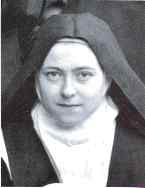
St. Thérèse as Joan of Arc

Description: St. Thérèse posed as St. Joan of Arc in a little play she composed and acted in for an anniversary of her sister Pauline (Mother Agnes of Jesus). It was taken on January 21, 1895. Imported from France.


Until the end of the world, I will spend my heaven doing good upon the earth.”

St. Therese of the Child Jesus,
Doctor of the Church

One of the most beloved Saints of the Church, and Our Blessed Mother’s most precious daughter, St. Therese of Lisieux, and her love and devotion to Our Lord, is a story that touches the hearts of millions. In the brief 24 years that she lived on this earth, her graces touched the lives of so many. Her shrine in Lisieux remains the largest building in the world dedicated to one person. And her motto (above) is truly one that she has lived to the fullest, both in life and as a Saint -- “The Little Flower”

The Novena is easy, and is most dear to the Little Flower. It is the Twenty Four “Glory Be To the Father’s Novena and there is a little story attached with this one.

Father Putigan, a Jesuit priest, began the Novena to Saint Therese of the Child Jesus on December 3, 1925, asking the glorious Saint for one great favour. For nine days, he recited the “Glory Be” 24 times thanking the Holy Trinity for the favours and Graces showered on Saint Therese during the 24 years that she lived on this earth. The good father asked Saint Therese that as a sign that his novena was being heard, he would receive from someone a freshly plucked rose. On the third day of the novena, an unknown person sought out Father Putigan and presented him with a beautiful rose.

Father Putigan began the second novena on December 24 of the same year, and as a sign, asked for a white rose. On the fourth day of this novena, one of the Sister-nurses brought him a white rose, saying, “Saint Therese sent you this”

Amazed the priest asked “where did you get this?”

“I was in the chapel,” said the Sister, “and as I was leaving, I passed the alter above which hangs the beautiful picture of Saint Therese. This rose fell at my feet. I wanted to put it back in the bouquet, but a thought came to me that you should have it.”


The Twenty-four 'Glory Be's’ Novena to St. Therese

Father Putigan received the favours he had petitioned of the Little Flower of Jesus, and promised to spread the novena to increase devotion to, and bring her more honour. In this fashion, from the ninth to the seventeenth of each month, those who want to participate in the 24 Glory Be’s novena, should add to those of their own, the intentions of all who are at that time making the novena, thus forming one great prayer in common. This novena can be said at any time, however.

The Glory Be is said 24 times each day for nine days, in thanksgiving for all the blessings and favours given to Saint Therese of the Child Jesus during the 24 years of her life. Start the novena each day with this prayer:

“Holy Trinity, God the Father, God the Son, and God, the Holy Spirit, I thank You for all the blessings and favours You have showered upon the soul of Your servant Therese of the Child Jesus, during the 24 years she spent here on earth, and in consideration of the merits of this, Your most beloved Saint, I beseech You to grant me this favour, if it is in accordance with Your most Holy Will and is not an obstacle to my salvation.”

After this prayer, follow with the 24 Glory Be’s, between each of which should be included this short prayer”

“Saint Therese of the Child Jesus, pray for us.”

Have you ever prayed this novena?