Saturday, December 29, 2007

St. Thomas Becket

A martyr, a saint, is always made by the design of God,
for His love of men, to warn them and to lead them,
to bring them back to His ways.

-St. Thomas Becket, speaking Christmas morning,
four days before he was martyred; his feast day is December 29.


The martyrdom of St. Thomas Becket


Have you ever taken the time to read about the life of St. Thomas Becket?


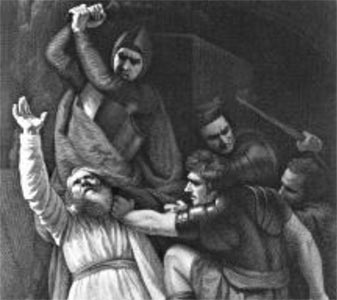
The Murder of Thomas Becket, 1170

Murder on the
altar's steps
A sword's crushing blow extinguished the life of Thomas Becket, Archbishop of Canterbury, on a cold December evening as he struggled on the steps of his altar. The brutal event sent a tremor through Medieval Europe. Public opinion of the time and subsequent history have laid the blame for the murder at the feet of Becket's former close personal friend, King Henry II.

Becket was born in 1118, in Normandy the son of an English merchant. His family was well off, his father a former Sheriff of London. Becket benefited from his family's status first by being sent to Paris for his education and from there to England where he joined the household of Theobold, the then Archbishop of Canterbury. Becket's administrative skills, his charm, intelligence and diplomacy propelled him forward. The archbishop sent him to Paris to study law and upon his return to England made him Archdeacon of Canterbury.

Becket's big break came in 1154, when Theobold introduced him to the newly crowned King, Henry II. The two hit it off immediately, their similar personal chemistries forming a strong bond between them. Henry named Becket his Chancellor. Archbishop Theobold died in 1161, and Henry immediately saw the opportunity to increase his influence over the Church by naming his loyal advisor to the highest ecclesiastical post in the land. Henry petitioned the Pope who agreed. There was only one slight hindrance. Becket, busy at court, had never been ordained. No problem, Becket was first invested as a priest. The next day he was ordained a Bishop, and that afternoon, June 2, 1162, made Archbishop of Canterbury.

If King Henry believed that by having "his man" in the top post of the Church, he could easily impose his will upon this powerful religious institution, he was sadly mistaken. Becket's allegiance shifted from the court to the Church inspiring him to take a stand against his king. In those days, the Church reserved the right to try felonious clerics in their own religious courts of justice and not those of the crown. Henry was determined to increase control of his realm by eliminating this custom. In 1163, a Canon accused of murder was acquitted by a church court. The public outcry demanded justice and the Canon was brought before a court of the king. Becket's protest halted this attempt but the action spurred King Henry to change the laws to extend his courts' jurisdiction over the clergy. Becket vacillated in his support of the king, finally refusing to agree to changes in the law. His stand prompted a royal summons to Henry's court at Northampton and the king's demand to know what Becket had done with the large sums of money that had passed through his hands as Chancellor.

"Who will rid
me of this
meddlesome
priest?"
Seeing the writing on the wall, Becket fled to France where he remained in exile for six years. The two former friends appeared to resolve their dispute in 1170 when King Henry and Becket met in Normandy. On November 30, Becket crossed the Channel returning to his post at Canterbury. Earlier, while in France, Becket had excomunicated the Bishops of London and Salisbury for their support of the king. Now, Becket remained steadfast in his refusal to absolve the bishops. This news threw King Henry (still in France) into a rage in which he was purported to shout: "What sluggards, what cowards have I brought up in my court, who care nothing for their allegiance to their lord. Who will rid me of this meddlesome priest."

The king's exact words have been lost to history but his outrage inspired four knights to sail to England to rid the realm of this annoying prelate. They arrived at Canterbury during the afternoon of December 29 and immediately searched for the Archbishop. Becket fled to the Cathedral where a service was in progress. The knights found him at the altar, drew their swords and began hacking at their victim finally splitting his skull.

The death of Becket unnerved the king. The knights who did the deed to curry the king's favor, fell into disgrace. Several miracles were said to occur at the tomb of the martyr and he was soon canonized. Hordes of pilgrims transformed Canterbury Cathedral into a shrine. Four years later, in an act of penance, the king donned a sack-cloth walking barefoot through the streets of Canterbury while eighty monks flogged him with branches. Henry capped his atonement by spending the night in the martyr's crypt. St. Thomas continued as a popular cultist figure for the remainder of the Middle Ages.

Observations of a Monk

Edward Grim, a monk, observed the attack from the safety of a hiding place near the altar. He wrote his account some time after the event. Acceptance of his description must be qualified by the influence that Becket's sainthood had on Grim's perspective. However, the fundamentals of his narrative are no doubt true. We pick up the story after the knights have stormed into the cathedral.

"The murderers followed him; 'Absolve', they cried, 'and restore to communion those whom you have excommunicated, and restore their powers to those whom you have suspended.'

"He answered, 'There has been no satisfaction, and I will not absolve them.'

'Then you shall die,' they cried, 'and receive what you deserve.'

'I am ready,' he replied, 'to die for my Lord, that in my blood the Church may obtain liberty and peace. But in the name of Almighty God, I forbid you to hurt my people whether clerk or lay.'

"Then they lay sacrilegious hands on him, pulling and dragging him that they may kill him outside the church, or carry him away a prisoner, as they afterwards confessed. But when he could not be forced away from the pillar, one of them pressed on him and clung to him more closely. Him he pushed off calling him 'pander', and saying, 'Touch me not, Reginald; you owe me fealty and subjection; you and your accomplices act like madmen.'

"The knight, fired with a terrible rage at this severe repulse, waved his sword over the sacred head. 'No faith', he cried, 'nor subjection do I owe you against my fealty to my lord the King.'

"Then the unconquered martyr seeing the hour at hand which should put an end to this miserable life and give him straightway the crown of immortality promised by the Lord, inclined his neck as one who prays and joining his hands he lifted them up, and commended his cause and that of the Church to God, to St. Mary, and to the blessed martry Denys. Scarce had he said the words than the wicked knight, fearing lest he should be rescued by the people and escape alive, leapt upon him suddenly and wounded this lamb who was sacrificed to God on the head, cutting off the top of the crown which the sacred unction of the chrism had dedicated to God; and by the same blow he wounded the arm of him who tells this. For he, when the others, both monks and clerks, fled, stuck close to the sainted Archbishop and held him in his arms till the one he interposed was almost severed.

"Then he received a second blow on the head but still stood firm. At the third blow he fell on his knees and elbows, offering himself a living victim, and saying in a low voice, 'For the Name of Jesus and the protection of the Church I am ready to embrace death.'

"Then the third knight inflicted a terrible wound as he lay, by which the sword was broken against the pavement, and the crown which was large was separated from the head. The fourth knight prevented any from interfering so that the others might freely perpetrate the murder.

"Let us away
knights:
He will rise
no more."
"As to the fifth, no knight but that clerk who had entered with the knights, that a fifth blow might not be wanting to the martyr who was in other things like to Christ, he put his foot on the neck of the holy priest and precious martyr, and, horrible to say, scattered his brain and blood over the pavement, calling out to the others, 'Let us away, knights; he will rise no more.'


References:
Abbot, Edwin A., St. Thomas of Canterbury (1898); Compton, Piers, The Turbulent Priest (1964); Hollister, Warren C., Medieval Europe: a short history (1975)

How To Cite This Article:
"The Murder of Thomas Becket, 1170" EyeWitness to History, www.eyewitnesstohistory.com (1997).


Monday, December 24, 2007

The 2007 Piano Christmas Recital


Michael, Anna, and Sophie participated in a piano recital December 23, 2007

They were numbers 35, 36, and 37 in order of performance among 37 performers.

Sophie played Andalusian Rhapsody (Brown) and Christmas Eve/Sarajevo 12/24 (Traditional).

Anna played Toccata (Alexander) and Boughs of Holly (Traditional)

Michael, Anna, and Sophie played Radetzky March (Piano Trio) (Strauss)

It was a wonderful and very memorable day for our family.

Miranda (who once took lessons from Pailin) turned the pages for the trio. She is expecting her third child on January 14, 2008.

Please pray for all pianists who are called to study and perform. They bring joy to all those who are fortunate to hear them play.

The 2007 Piano Christmas Spirit

Saturday, December 22, 2007

The Lion and The Lamb

PEACE BE WITH YOU JIGSAW PUZZLE -- This 550 piece puzzle features inspirational artwork by William Hallmark. The image is based on Luke 24:36 and shows a lion and a lamb sitting together under a rainbow. When completed, this puzzle measures 18" by 24".


Our family received this puzzle as a Christmas gift this year from a generous Franciscan Catholic Priest and His Order of Franciscan Friars


Motivated to research The Lion and The Lamb, I found the following sermon informative and inspirational.


The Lion and the Lamb


A sermon on Revelation 5 by Coty Pinckney, Desiring God Community Church, Charlotte, NC, 4/24/2005


What is your favorite picture of Jesus? I don’t mean a painting or illustration, but your favorite image.

  • For some of us who were brought up going to Sunday School, the image might be from Matthew 19:14: “Let the little children come to me.” Jesus is sitting, smiling, with a child on one knee and several other children around Him.
  • Others from Christian homes may have had a picture in our house of a kindly-looking Jesus with long brown hair, who looked a lot more Italian than Jewish. Perhaps that has become your favorite image.
  • For others, their favorite image might be Jesus in the Garden in agony,
  • Or Jesus suffering on the cross for your sins and mine,
  • Or the resurrected Jesus going up to Mary Magdalene outside the tomb, calling out to her, “Mary!”
  • Or the risen Lord speaking to skeptical Thomas: “Put your finger in my hands; put your hand in my side. Stop disbelieving and believe!”

Other than the Italian features in the painting, these are all biblical images. God communicates the nature of Jesus to us through such images.

But our favorite images of Jesus lead to a danger:We may choose to think of Jesus in those terms – and NOT in others. There is always a danger of our focusing on one true aspect of Jesus’ character and, by overemphasizing that, misunderstanding and thus misrepresenting the person Jesus.

We must remember a basic principle of biblical interpretation: Use Scripture to understand Scripture. Look at the entirety of Scripture to keep our theological understanding in balance.

Thus Paul says to Ephesian elders:

I testify to you this day that I am innocent of the blood of all of you, for I did not shrink from declaring to you the whole counsel of God. Acts 20:26-27

The whole counsel of God. That is what we are to preach – and that should form the background for every theological position we hold.

What is heresy? Heresy is not complete falsehood. Heresy always has a basis in truth. Heresy is picking up on one truth and running with it, at the expense of other truths. Heresy is getting your theology out of biblical balance. We want to avoid heresy! So we look to the whole counsel of God, and we are committed through expository preaching to teach through the whole counsel of God.

In today’s text, Revelation 5, John himself is confronted with two very different images of Jesus back to back. The vision God gives him juxtaposes, puts right next to each other, two views of Jesus: Jesus as the Lion of Judah; Jesus as the slain yet living Lamb.

This is a puzzle: How can it be accurate to describe anyone as both Lion and Lamb? I pray that God would use this text to open our eyes to both these truths, so that you might give glory to Jesus, as you see the contrasting aspects of His character and delight in Him for Who He is.

We’ll proceed by first reminding you of the setting of this chapter, then look in turn at:

  • The Scroll
  • The Lion
  • The Lamb
  • Jesus: Lion AND Lamb

The Setting

Recall that in Revelation 4, John sees a vision of throne room of God (see sermon). In this room, God is right at the center. Around Him, praising Him, are four living creatures, representing everything that has breath. Around them are 24 more thrones, with 24 elders seated on them. These elders seem to represent all the redeemed of all time. They acknowledge that everything they have, all their rewards, all their accomplishments come from God. So they praise Him as the source of all, the creator, the One who freely chose to create.

Last week we looked ahead into chapter five to see that there are a series of concentric circles going out from the throne: The creatures, the elders, and then thousands and thousands of angels praising God. Then around the angels, every creature in heaven and on earth and under the earth praising Him. The point? God is supreme, God is central.

Yet John hardly describes God at all. Out of reverence He does not even name Him, referring to Him as the “one seated on the throne.” God is bright, beautiful, like shining precious stones; God is mighty, indeed, frightening as lightning and thunder come out from Him. But it seems He is hard to see. There is only brightness at the center of the circles.

The Scroll

But then, something at the center becomes clear:

Then I saw in the right hand of him who was seated on the throne a scroll written within and on the back, sealed with seven seals. And I saw a strong angel proclaiming with a loud voice, "Who is worthy to open the scroll and break its seals?" Revelation 5:1

What is this scroll or book that is in the hand of God? Similar images are used several times in the Old Testament, and several more times in the rest of Revelation. In these biblical references, a book is often a record of judgment. Other times – and occasionally at the same time – a book is a record of God’s mercies on His people.

Daniel 7 seems to be closest Old Testament image to what we find in Revelation 5. Consider Daniel 7:9-11:

As I looked, thrones were placed, and the Ancient of days took his seat; his clothing was white as snow, and the hair of his head like pure wool; his throne was fiery flames; its wheels were burning fire. 10 A stream of fire issued and came out from before him; a thousand thousands served him, and ten thousand times ten thousand stood before him; the court sat in judgment, and the books were opened. 11 I looked then because of the sound of the great words that the horn was speaking. And as I looked, the beast was killed, and its body destroyed and given over to be burned with fire.

Like Revelation 5 and 6, this is a throne room scene, featuring books that are opened, followed by God’s judgment of His enemies. The opening of the book seems to lead to the judgments.

But keep reading in Daniel 7, beginning in verse 13:

13 I saw in the night visions, and behold, with the clouds of heaven there came one like a son of man, and he came to the Ancient of Days and was presented before him. 14 And to him was given dominion and glory and a kingdom, that all peoples, nations, and languages should serve him; his dominion is an everlasting dominion, which shall not pass away, and his kingdom one that shall not be destroyed.

This too follows the opening of the book: The reigning of one like a Son of Man, who will be served by all peoples, nations, and languages. His kingdom shall not be destroyed.

There are striking similarities here to Revelation 5, where the Lamb receives something from the one seated on the throne, and is praised by al peoples, languages, and nations.

While the other Old Testament images are not as closely in parallel, they nevertheless give us insight into the nature of the book. For example, in Malachi 3 and 4, when some of the people claim that it doesn’t pay to follow God, He tells them that a “book of remembrance” is written, featuring those who “feared the Lord and esteemed His Name.” This book leads to a distinction between the righteous and the wicked, with the righteous rewarded and the wicked punished. So the book, once again, is about justice and mercy.

We could look at other references to books, such as Isaiah 30, 34, and 65. But all seem to point in the same direction: The scroll or book in Revelation 5 is of God’s plan of redemption, His plan finally to right all wrongs, to implement justice, to administer mercy to His own, to create a people for His own possession.

With that in mind, let’s read verses 2 to 4:

And I saw a strong angel proclaiming with a loud voice, "Who is worthy to open the scroll and break its seals?" 3 And no one in heaven or on earth or under the earth was able to open the scroll or to look into it, 4 and I began to weep loudly because no one was found worthy to open the scroll or to look into it.

Three obvious questions: Why is opening so important? Why does John weep loudly when no worthy person comes to open it? And why is no one worthy to open it?

The book of Daniel again helps us understand this issue. In chapter 12, Daniel is told to seal his book:

But you, Daniel, shut up the words and seal the book, until the time of the end. Daniel 12:4

Then I said, "O my lord, what shall be the outcome of these things?" 9 He said, "Go your way, Daniel, for the words are shut up and sealed until the time of the end. Daniel 12:8-9

Daniel’s book is sealed, not to be opened during his lifetime. But it will be opened! When? At “the time of the end”. When is that?

Do you remember what Peter says on the day of Pentecost? In Acts 2:16, he says that what the people see happening on that day is a fulfillment of a prophecy from the book of Joel. But that prophecy is prefaced with the words, “in the last days”. Thus, “the last days”, “the time of the end”, began at Pentecost and continues on up to today. Peter was living in the last days – and so are we. So the opening of the seals is emphasizing to John that the “time of the end” is here.

Indeed, the book is not only a record of God’s work in the last days, it also plays an important part in bringing God’s plan to completion. The opening of the book vindicates God, as it leads to His final judgment of His enemies and final perfection of His people.

In setting these processes in motion, the opening of the book eventually leads to the end of creation as we know it. Indeed, it brings to an end the day of salvation. Jesus says something similar at the end of His earthly ministry:

The light is among you for a little while longer. Walk while you have the light, lest darkness overtake you. John 12:35

Jesus has been in the world, as light coming into darkness. He, the Son of God, the second Person of the Trinity, has been shining the light of truth in all the dark places of the world. Yet He is about to leave. So He says, “The Light is with you! Yet the Light is leaving! So see who I am! Respond today! Don’t put it off!”

Then, remember Noah (see sermon)? He is another example of this. Scripture calls him a preacher of righteousness (2 Peter 2:5). Surely he called the people of his day to repentance. He told them the flood was coming. He pleaded with them to believe in God, to join him in building the ark, and to escape from the coming destruction. But the final day came, and God told him to enter the ark with his family. The opportunity for salvation came to an end. Who ended that opportunity? Not Noah. God. According to Genesis 7:16, God closed the door of the ark, protecting Noah and his family, and shutting out all the others. Once the waters rose, all those were now desperate to escape – but the day of salvation had passed.

Just so in Revelation: The opening of the book sets in motion activities that will eventually bring to an end the day of salvation. Thus, the one to open the seals must be worthy to bring about that judgment. But who is worthy?

Do you remember the story of the woman caught in adultery? The Pharisees drag this woman before Jesus, and ask Him what should be done to her. The penalty for adultery, according to the Law, is death by stoning. Jesus agrees with the penalty, but says:

Let him who is without sin among you be the first to throw a stone at her. John 8:7

No one is worthy to judge. No one worthy is worthy to wreak vengeance, to do justice. For ultimate justice to hold, only a sinless one can effect that justice.

This is what we find in Revelation 5. The book must be opened if every wrong is to be righted, if justice is to be done. Yet there is no one without sin. No one is worthy to judge. So John weeps and weeps: for his own sinfulness, for the sinfulness of the human species, for the lack of justice.

The Lion

But that’s not the end of the story!

And one of the elders said to me, "Weep no more; behold, the Lion of the tribe of Judah, the Root of David, has conquered, so that he can open the scroll and its seven seals." Revelation 5:5

There is one who is worthy! There is one member of the human race who has not sinned: The Lion of the tribe of Judah!

Why is Jesus called a lion? Lions are powerful and dangerous. Lions are majestic - even in Jesus’ day, the lion was a symbol of royalty.

This is a specific reference to the prophecy that Jacob gave about the descendants of Judah in Genesis 49:

9 Judah is a lion's cub; from the prey, my son, you have gone up. He stooped down; he crouched as a lion and as a lioness; who dares rouse him? 10 The scepter shall not depart from Judah, nor the ruler's staff from between his feet, until tribute comes to him; and to him shall be the obedience of the peoples. Genesis 49:9-10

“The scepter shall not depart from Judah” – and thus his kingdom will be an everlasting kingdom. “To him shall be the obedience of the peoples” – and thus every tribe and tongue and people and language will serve Him. Since Jesus is a descendant of Judah, all this is fulfilled in the images of Revelation 5.

The angel also refers to Jesus as the “Root of David”. This term comes from Isaiah 11 (although there He is called the “Root of Jesse”, David’s father):

There shall come forth a shoot from the stump of Jesse, and a branch from his roots shall bear fruit. 2 And the Spirit of the LORD shall rest upon him, the Spirit of wisdom and understanding, the Spirit of counsel and might, the Spirit of knowledge and the fear of the LORD. 3 And his delight shall be in the fear of the LORD. He shall not judge by what his eyes see, or decide disputes by what his ears hear, 4 but with righteousness he shall judge the poor, and decide with equity for the meek of the earth; and he shall strike the earth with the rod of his mouth, and with the breath of his lips he shall kill the wicked. 5 Righteousness shall be the belt of his waist, and faithfulness the belt of his loins. . . . the earth shall be full of the knowledge of the LORD as the waters cover the sea. 10 In that day the root of Jesse, who shall stand as a signal for the peoples- of him shall the nations inquire, and his resting place shall be glorious. Isaiah 11:1-5, 9b-10

This passage pictures a perfect king, a king who will bring justice to the poor and the weak, a king who will punish the wicked by killing them with the breath of his lips, and striking the earth with the rod of his mouth.

So John expects to see a mighty, powerful, majestic Lion. He expects to see one who is able to overcome all opposition! This is the person he expects to take the scroll.

But that is not what he sees at all:

The Lamb

And between the throne and the four living creatures and among the elders I saw a Lamb standing, as though it had been slain, with seven horns and with seven eyes, which are the seven spirits of God sent out into all the earth. Revelation 5:6

John hears a description of the Lion – then looks, and sees something completely different. This happens several times in Revelation. The contrast sheds light on the character of what is heard and seen.

Imagine John’s surprise: He sees not a Lion but a Lamb! And even the Lamb is not mighty and powerful, but one who is “as slain.” (There is no need to translate this “as though it had been slain”. That translation makes it look as if the Lamb only appeared to be slain. But the Lamb is really slain! So “as slain” or “as one who was slain” is a better translation.)

What is the image of the lamb in Scripture? There are almost 200 references in Scripture to lambs; the vast majority of these refer to lambs killed as sacrifices. The most important of these references for us is in Isaiah 53, the passage about the suffering servant, dying for His people. He is said to be “like a lamb that is led to the slaughter” (v7). Why? Because “the LORD has laid on him the iniquity of us all” (v6).

Sin requires judgment. God told Adam in the Garden that he would die the day he ate of the tree of the knowledge of good and evil. Every sinner is subject to that death sentence. Justice must be done. But God provides a substitute, God provides a lamb on whom He can put the sin of those He saves. So God exercises justice, seeing that every sin is punished; and God exercises mercy, forgiving those who believe by putting their sins on the Lamb of God.

The Lamb must be spotless. Otherwise, the Lamb would have to die for His own sins. But since Jesus was sinless, He was the perfect sacrifice. As the book of Hebrews says:

in every respect has been tempted as we are, yet without sin. Hebrews 4:15

He did not have to die for His sins. So He was able to take on the sins of all those who believe in Him.

As we pointed out last week, the Lamb is literally “in the midst of the throne.” We should have remembered this from Revelation 3:21, since Jesus said there,

“I sat down with my Father on His throne.”

So He gets up from the throne, and takes the scroll from the right hand of God the Father Almighty. So the four living creatures and 24 elders – everything that has breath – worship Him.

Now slow down: Is this right? Is it right for these creatures and elders to worship the Lamb? Twice in Revelation John begins to worship angels, and they rebuke him, telling him to worship God alone (See, for example, 19:10). But there is no rebuke here! The Lamb of God, the Lion of Judah, is God Himself! He is worthy of worship! He is the second person in the Trinity!

As saw four weeks ago (see sermon), in the rest of the chapter, all creation praises him for being worthy to take the book and open its seals. For by His death He ransomed people. And He ransomed them for a purpose: For God! To bring glory to God! Thus He is worthy of all praise, all glory, all honor – and He will receive it in full.

Lion and Lamb

So to see Jesus fully, to see Him in all His complexity, we need to see Him as both Lion and Lamb. He is a Lamb, truly. He is a Lion, truly.

Why do we need this balanced view of Jesus as Lion and Lamb? Why is this important? What are the dangers of overemphasizing Jesus as Lion, or overemphasizing Him as Lamb? How can the biblical truth concerning the character of Jesus be distorted by not keeping in balance the whole counsel of God?

We’ll look at three unbalanced views of Jesus: One that overemphasizes His being a Lion, and two that overemphasize His being a Lamb.

Unbalanced View 1: The Avenging Lion

The first false view will say about Jesus:

“He will come to judge my enemies. He will protect me, and wreak vengeance on those who have harmed me. So you enemies, watch out! The Lion is going to get you!”

Is there truth here? By all means! Jesus is the Lion! Jesus will wreak vengeance on all His enemies. He will destroy those who trample His Name. He will watch over His people and protect them. We need not fear; We cannot be killed while His purpose for us remains.

Yet this is a false view. This particular view was characteristic of first century Jews. They were expecting a political Messiah, a Messiah who would come and free them from the oppressive Romans. They hated the Romans, and saw their political liberation as vitally important. Thus, when Jesus came as a Lamb, they did not recognize Him.

Consider also the Crusaders in the Middle Ages. They looked to Jesus to defeat the infidels who had control of Jerusalem. And no matter how horrible their behavior, no matter how vilely they treated people, they looked to Jesus to be their avenging Lion on all their enemies.

But do we see this false view today? Very often. Consider those who claim that God is on the side of one political party or another, one candidate for public office or another.

This false view creeps in whenever we think, “I’m a believer, so God is against MY enemies.” Thus, God becomes a tool, an instrument in your hand used to wield your power and to effect your purposes. You think of your human enemies as THE enemy – and you expect Jesus, the Lion, to fight against them.

But we must remember that Jesus is the Lion and the Lamb! He can be the Lamb who was slain for YOUR enemies! He may intend to conquer your enemies with love, and not with might; He may intend to bring your enemies to Himself through your witnessing of His grace. He may bring your enemies to Himself through your death! So “love your enemies, and pray for those who persecute you” (Matthew 5:44). For you can be the means by which your enemies see the Lamb!

Unbalanced View 2: The Gentle Lamb

Those with this view say, “Jesus is the Lamb of God who takes away the sin of the world! He died to give life to His enemies! He is so gracious, so kind, so forgiving! He is the perfect revelation of God’s love!

“So will this Lamb hurt anyone? How could He be the perfect lamb if He did? He may discipline people, He may correct them – but He must not send anyone to hell for all eternity! That’s horrible! That’s just a carryover from an earlier, outdated view of God. This is the true revelation: The dying Lamb! Forgiveness in God, available to all!”

Is there truth in that view? By all means! Jesus is the Lamb of God who takes away the sin of the world. He is gracious and forgiving. He is the servant of all, who died willingly to be a substitute for sinful man. He is the Redeemer of all who come to Him in faith.

But we must remember that Jesus is the Lamb and the Lion! How we need this image of Jesus as lion!

Already in Revelation we’ve seen powerful images of an avenging Jesus: In 2:16 He wages war against His enemies with the sword of His mouth; in 2:23, He promises to strike dead the children of the Jezebel-like woman in Thyatira. We will see much more graphic pictures of the wrath of the Lamb in the weeks ahead.

Jesus is loving, kind, forgiving, and merciful – Jesus is the Lamb. Praise God!

But Jesus also executes perfect justice; He slaughters His enemies; He defends the honor of God – Jesus is the Lion.

Hold on to both truths.

Unbalanced View 3: Jesus, MY Lamb

Those who hold to this view say, “Jesus is the Lamb of God who died for me. He paid the penalty for my sins. He loves me with an everlasting love. Therefore, I must be really special! I must be wonderful! God doesn’t love trash! How great I am!”

This false view is exemplified in the lyrics to a recent song by Lenny LeBlanc and Paul Baloche, entitled “Above All.” This song starts with wonderful lyrics, but then ends with these words:

Like a Rose trampled on the ground
You took the fall and thought of me above all.

Is there truth here? Precious truth! Jesus died to redeem a people for Himself! He died not for mankind in general, not for a class of people, but for each of His people in particular. We sang earlier today, “My name is graven on His hands, My name is written on His heart.” Love that truth! Take great joy in that truth!

But man is not at the center! God is at the center! And this false view puts man at the center.

Why did Jesus suffer on the cross? What was He thinking of? What does Jesus Himself tell us?

27 "Now is my soul troubled. And what shall I say? 'Father, save me from this hour'? But for this purpose I have come to this hour. 28 Father, glorify your name." Then a voice came from heaven: "I have glorified it, and I will glorify it again." John 12:27-28

The glory of God! That is what Jesus thought of above all! The glory of God, as fulfilled in Revelation 5:13, when every creature - all those who weren’t worthy to open the scroll in verse 3 - give glory to God and the Lamb forever and ever.

Jesus is the Lamb who aims to glorify God for His mercy. Jesus is the Lion who aims to glorify God for His justice. We must hold on to both!

So instead of singing of this truth in a man-centered way, “You took the fall and thought of me above all,” we can express this precious truth in a God-centered way, “Amazing love! How can it be that thou my God shouldst die for me.”

Conclusion

Jesus is the Lion and the Lamb. He is the King, coming to wreak vengeance on His enemies; He is the gentle lamb, dying for His people. As Isaiah writes:

Behold, the Lord GOD comes with might, and his arm rules for him; behold, his reward is with him, and his recompense before him. 11 He will tend his flock like a shepherd; he will gather the lambs in his arms; he will carry them in his bosom, and gently lead those that are with young. Isaiah 40:10-11

He comes to rule, He comes to pay back His enemies; He comes to gently carry His lambs.

See Him in His entirety! See Him in ALL His glory! Don’t try to tame Him, to limit Him, to box Him in!

  • Love Him as the Lamb, dying for your sin!
  • Love Him as the Lion, with all authority, might, and power!
  • Love as the bridegroom, coming for His church!
  • Love Him as the conquering, vengeful King with the bloody robe!

Love the complete Christ – and rejoice that He is king.


This sermon was preached at Desiring God Community Church in Charlotte, NC on 4/24/05. Greg Beale’s The Book of Revelation (Eerdmans, 1999) was helpful, particular on the Old Testament parallels. The song “Above All” by Lenny LeBlanc and Paul Baloche is copyright 1999 by Integrity’s Hosanna! Music. I also quote the songs, “Before the Throne of God Above” by Charitie Lee Bancroft and “And Can it Be” by Charles Wesley.

Copyright © 2005, Thomas C. Pinckney. This data file is the sole property of Thomas C. Pinckney. Please feel free to copy it in written form, but only in its entirety for circulation freely without charge. All copies of this data file must contain the above copyright notice.

This data file may not be copied in part, edited, revised, posted on the internet, copied for resale or incorporated in any products offered for sale, without the written permission of Thomas C. Pinckney, (send email), c/o Desiring God Community Church, PO Box 620099, Charlotte, NC 28262.


Isaiah 11:6 (Douay-Rheims Bible)


The wolf shall dwell with the lamb: and the leopard shall lie down with the kid: the calf and the lion, and the sheep shall abide together, and a little child shall lead them.


How much have you thought into Christ being both Lion and Lamb?


Tuesday, December 18, 2007

Enthronement of The Sacred Heart In Homes

Enthronement of the Sacred Heart in the Home
Nihil Obstat and Imprimatur: 1962


FOR THE ENTHRONEMENT KIT:

This is an option for those who prefer, but it is not necessary.

<>The National Enthronement Center
Box 111
Fairhaven, MA 02719
Tel. (508) 999-2680
or
(508) 993-2442 <>

IMAGE OF THE SACRED HEART


CONTENTS:

Founder of the Enthronement
Pontifical Approval
Object and Spirit of the Enthronement
Enthronement and Our Times
The Enthronement Ceremony
Junior Apostles of the Sacred Heart
Suggested Practices and Prayers
Night Adoration
Sacred Heart External Links


Have you ever considered protecting your home through The Enthronement of The Sacred Heart?

Friday, December 14, 2007

St. John of The Cross

StatCounter - Free Web Tracker and Counter

Thursday, December 13, 2007

St. Lucy

http://www.cukierski.net/st.lucy.jpg

Eutychia had arranged a marriage for Lucy with a pagan bridegroom, but Lucy urged that the dowry be spent on alms so that she might retain her virginity. Euthychia suggested that the sums would make a good bequest, but Lucy countered, "...whatever you give away at death for the Lord's sake you give because you cannot take it with you. Give now to the true Savior, while you are healthy, whatever you intended to give away at your death."[4] News that the patrimony and jewels were being distributed came to the ears of Lucy's betrothed, who heard from a chattering nurse that Lucy had found a nobler Bridegroom.

Her rejected pagan bridegroom denounced Lucy as a Christian to the magistrate Paschasius, who ordered her to burn a sacrifice to the emperor's image. Lucy replied that she had given all that she had: "I offer to Him myself, let Him do with His offering as it pleases Him." Sentenced to be defiled in a brothel, Lucy asserted:

No one's body is polluted so as to endanger the soul if it has not pleased the mind. If you were to lift my hand to your idol and so make me offer against my will, I would still be guiltless in the sight of the true God, who judges according to the will and knows all things. If now, against my will, you cause me to be polluted, a twofold purity will be gloriously imputed to me. You cannot bend my will to your purpose; whatever you do to my body, that cannot happen to me.[4]

The Christian tradition states that when the guards came to take her away they found her so filled with the Holy Spirit that she was stiff and heavy as a mountain; they could not move her even when they hitched her to a team of oxen. Even with a dagger through her throat she prophesied against her persecutor. As final torture, her eyes were gouged out. She was miraculously still able to see without her eyes. In paintings and statues, St. Lucy is frequently shown holding her eyes on a golden plate.

O God, our Creator and redeemer, mercifully hear our prayers that as we venerate Thy servant, Saint Lucy, for the light of faith thou didst bestow upon her, Thou wouldst vouchsafe to increase and to preserve this same light in our souls, that we may be able to avoid evil, to do good and to abhor nothing so much as the Blindness and the darkness of evil and of sin.

Relying on Thy goodness, O God, we humbly ask Thee, by the intersession of Thy servant, Saint Lucy that Thou wouldst give perfect vision to our eyes, that they may serve for Thy greater honor and glory, and for the salvation of our souls in this world, that we may come to the enjoyment of the unfailing light of the Lamb of God in paradise.

Saint Lucy, Virgin and martyr, hear our prayers and obtain our petitions.

Do you have difficulty or problems with your eyes?


Friday, December 7, 2007

Sunday, December 2, 2007

Relieve Stress and Anxiety

Three Ways To Relieve Stress

Three good ways to relieve stress that you can start using today.


Of all the ways to relieve stress, meditation may be one of the best, but what if you don't have the time? What if you are having trouble with your meditation? Try one of the following three good techniques. They don't even require any practice.

Breath To Relieve Stress

If you don't feel like meditating or just don't have the time, you can at least stop for one minute to just breath. Just breath deeply through your nose and let the tension drain from your muscles as much as possible. Give special attention to the tightness in your face and shoulders. Deep breathing, even for a minute, can relax you significantly.

Resolve Your Stressors

As I was sitting here getting ready to write this, something was bothering me. On reflection, I realized I've been putting off making a phone call. I needed to tell a acquaintance that I couldn't testify in court as I said I would. She was disappointed, but as soon as I made the call I felt more relaxed.

Simply making decisions and taking action can be one of the most immediate ways to relieve stress. Take a moment whenever you feel stressed, identify the things in your mind that are contributing to your state, and then do something about them. That's all there is to this simple technique.

Almost. Naturally, you can't resolve everything that is bothering you at any given moment. Still, what you can do is take some action. Indecisiveness, waiting, wondering and worrying cause stress. Even if you just make a list of what you need to do, your mind will often let these things go. Start a list, talk to someone, make a decision - just do something to let the stressor go.

Do Things You Enjoy

On Friday nights, when I play chess at the coffee house, I don't think about anything else for four hours. When you are totally engaged in an activity, there isn't room for stressful thoughts. Fully engaged, though, usually means that it's something we enjoy doing.

While physical activity has some advantages, you can try doing anything that you can put your whole mind into. That could be reading a good book, cooking, or playing with the dog. Notice which activities really engage you and let you drop your worries, and keep that mental list handy for whenever you are stressed. When your passionate activity is also your job or business, this can be one of the best ways to relieve stress.

Steve Gillman has meditated and studied meditation for over twenty years. You can find a good mindfulness exercise and subscribe to The Meditation Newsletter at: http://www.TheMeditationSite.com


1. DON'T USE FOOD AS AN ANXIETY RELIEVER

If you realized how much of an effect food has on your mental state, you'd be a lot less tempted to overdo the treats, says Southern California physician Barnet Meltzer, M.D., author of Food Swings. "When people overeat, especially sweets and desserts, it can tax the nervous system and trigger mood swings, anxiety, grogginess or feeling `down,'" he says.

To avoid that, Meltzer recommends "mindful eating"--paying attention to what you put in your pie hole instead of thoughtlessly nibbling on every Rice Krispies square in sight. "Don't use food as a stress reducer," he adds. "If you're moody and cranky and irritable, it's harder to tell the difference between hunger and appetite--but the overeating that results will just make you moodier."

2. STAY ACTIVE

While reams of research have found that consistent workouts help relieve stress and keep your mood up, it stands to reason that the reverse is also true, says sports psychologist Rod Dishman, Ph.D., professor of exercise science at the University of Georgia in Athens. That is, if you let your exercise program lapse during the wintertime--as so many guys do--life's ordinary tensions can start to build up into a great big pile o' stress. So if you're thinking about lazing around for a month or three, remember that the result may be a sour attitude as well as a flabby gut. If you can't maintain a serious workout schedule, commit to a bare minimum of three brisk 30-minute walks per week.

3. SNOOZE OR LOSE

Anyone who's ever laid in bed at night pondering his full schedule or empty wallet knows well that anxiety can lead to sleeplessness--but it works the other way around, too. In a recent survey by the National Sleep Foundation, two-thirds of respondents said they are more likely to be impatient and aggravated with small annoyances when they don't get enough shut-eye. That's no surprise, since a lack of sleep is known to disrupt the body's ability to replenish hormones that affect both physical and mental health.

If you're missing out on z's around the holidays, it may be because your sleep schedule is out of whack. Try focusing on better "sleep hygiene":

* Go to bed at a decent hour and get up at the same time every day.

* Don't eat a lot of food, drink alcohol or exercise within three hours of bedtime.

* Block out worries by picturing yourself in a relaxing situation.

4. LIMIT THE CAFFEINE

It happens every time: Less sleep leads to more caffeine leads to less sleep.... but that's not the only problem with overdoing the coffee, tea and cola drinks. A recent study at Duke University found that people who consume caffeine feel more stressed and produce higher levels of stress hormones such as cortisol all day long. Not only will these hormones keep you edgy, they can also lead to increased fat deposition at the worst time of the year.

If you feel tense, try cutting back on caffeinated beverages--but do it gradually, as going cold turkey could give you a couple of days of withdrawal symptoms, such as headaches.

5. FIND SOME TIME TO RELAX EACH DAY

"Deep relaxation" breaks can help you deal with stresses whenever they occur. Take a yoga class; practice meditation (one of the simplest methods merely calls on you to close your eyes and count every breath for 20 minutes, restarting whenever you lose track); or just listen to relaxing music in a dim room--this is the time to try out those "new age" gift CDs you've been using for coasters.

6. REWORK YOUR JOB

Around the holidays, the atmosphere at work can come frighteningly close to jolly--people share food and gifts, leave early, take vacations, attend parties, and in between stand around chatting about it all. Unfortunately, this can also lead to less productivity, even though in many cases there's as much to do as ever--or even more if you need to prepare for inventories, taxes or other issues that demand attention at the beginning of the year. The result is often a sudden realization that you're falling behind, and the office fun can quickly turn into stress.

You can avoid this by planning ahead:

* Get as much done as you can early in the season, before the impending holidays start to slow you down.

* Encourage everyone else whose work you depend on to do so too.

* Make a list of must-dos and should-dos, and make sure the former is completed before the season saps everyone's energy.


Will you continue reading this article?


1 - 2 - 3 - Next


Saturday, December 1, 2007

Christmas Customs


The Customs of Christmastide

X

Christmas Eve Customs

Christmas Customs

Epiphany Customs

Christmas Eve Customs

X

  1. Christmas Tree | 2. Sacred Leisure | 3. Dinner and Celebration

4. Christmas Candle

5. Lights in the Window | 6. Midnight Mass 7. Holy Night

1. The Christmas Tree

As mentioned elsewhere, the Christmas tree was traditionally put up only on Christmas Eve and taken down on Twelfth Night, the Vigil of the Epiphany. The reason for this is that contrary to popular belief, the Christmas tree was not a Christian "baptism" of pagan yule traditions, but an entirely Christian symbol. In the Eastern churches December 24 was the Feast of Adam and Eve, our first parents. Though this feast has never been

observed in the Latin calendar, church officials nevertheless allowed Roman Catholics to appropriate this Oriental custom. In the Middle Ages special mystery plays were held on this day which featured a Paradise Tree, a tree representing both the Tree of the Knowledge of Good and Evil as well as the Tree of Life from the Garden of Eden. Thus the tree was decorated with apples (for the forbidden fruit) and sweets (for the Tree of Life). When the mystery plays were suppressed during the fifteenth century, the faithful moved the Paradise trees from the stage into their homes. The apples were later substituted for other round objects (such as shiny red balls), and lights and the Star of Bethlehem were added, but the symbolism remained essentially the same. Thus, our modern Christmas tree is actually the medieval Paradise tree, a reminder of the reason why God deemed it important to become man in the first place and a foretaste of the sweet Tree from which our Lord's birth would once again enable us to taste. The lights of the Christmas tree also form a glowing Jesse tree, with each light representing one of Christ's ancestors and the Star representing our Lord Himself.

2. Making Room for Sacred Leisure

According to an ancient (and practical) tradition, by Christmas Eve the house is to be thoroughly cleaned, all tasks finished or removed from sight, all borrowed items returned, and no task allowed to be begun that cannot be finished by nightfall.

3. Christmas Eve Dinner and Celebration

Most people associate Christmas feasting with the dinner on Christmas Day, and rightfully so, for as a Vigil Christmas Eve was traditionally a day of abstinence and fasting. Yet there were also delicious Christmas Eve dinners that conformed to this

restraint (see Foods). Afterwards, the family would gather around the newly decorated Christmas tree, reciting Vespers or praying and singing hymns to the infant Jesus now in the crib (the figurine had been conspicuously absent during Advent). In some countries, it was at this time that gifts were exchanged.

4. The Christmas Candle

One of the most symbolically rich customs of Christmas Eve was the Christmas candle, a large white candle representing Christ. In Ireland, a Christmas candle was bedecked with holly and lit. It would burn through the night and

be relit on each of the twelve nights of Christmas. The entire family would pray before the candle for their living and departed loved ones. In England and Ireland the Christmas candle often consisted of three individual candles molded together in honor of the Trinity, while in Germany a highly decorated pyramid of smaller candles called a Weihnachtspyramide was used.

5. Lights in the Window

Another Irish custom during Christmastide was putting lights in the window. This practice originated during the times of persecution, when Mass had to be held in secret. Faithful Irish believers would place a candle in the window on Christmas Eve as a sign to any priest who happened by that this home was a safe haven in which Mass could be offered. When interrogated by the British about the meaning of this practice, the Irish replied that the lights were an invitation for Joseph and Mary to stay the night. Unthreatened by this supposed superstition, the British left them alone.

6. Midnight Mass

See Christmas Customs.

7. Holy Night

Some say that ever 'gainst that season comes

Wherein our Saviour's birth is celebrated,

The bird of dawning singeth all night long:

And then, they say, no spirit dare stir abroad;

The nights are wholesome; then no planets strike,

No fairy takes, no witch has power to charm,

So hallow'd and gracious is the time. --Hamlet I.i

Since ancient times, popular folklore has attached a wondrous goodness to the night before Christmas. Like Shakespeare's Hamlet, many Catholics believed that there was not only a special charm about this night, but a holiness. Nature awoke with unbounded joy in the middle of the night to greet its Maker: bees hummed sweet symphonic hymns, cattle fell on their knees in adoration, and trees and plants bowed in the direction of Bethlehem. No wicked spirits roamed the earth on this night, no evil forces prevailed, for on this night God had blessed the earth with His Son. Consequently, one hour before midnight, some churches in the British Isles would toll their bells mournfully as if for a Requiem and then peal joyfully at the stroke of twelve. The funereal ringing was called the "Devil's funeral" to indicate Satan's demise at the birth of Christ.

Christmas Customs

X

1. The Three Masses | 2. Christmas Greeting | 3. Pageants

4. Gift-giving | 5. Plants | 6. The Carol, "The Twelve Days of Christmas"

7. The Twelve Days of Christmas

8. St. Stephen's Day | 9. St. John's Day | 10. Innocents' Day

11. St. Sylvester Celebrations | 12. Feast of the Circumcision

13. Feast of the Holy Name of Jesus

1. The Three Masses

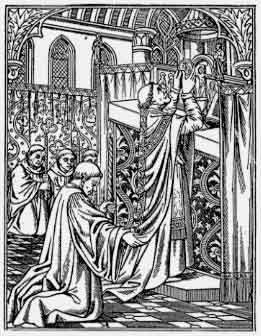
In the traditional Roman rite three Masses are celebrated on Christmas Day in honor of the various aspects of the mystery of the Incarnation. The First Mass, commemorating the eternal generation of the Son from the Father, is usually celebrated at midnight, the hour it is believed that the Lord was born. Midnight Mass, or the "Angels' Mass," is a cherished tradition among many Catholics,

even though the Roman rite does not require the First Mass to begin at that time (in Spain the First Mass begins at 3 a.m.). Solemn Vespers or Hymns and Carols are sung immediately prior to Midnight Mass, during which time the church bells are rung. Some countries also hold special feasts after the Mass (see Foods).

The Second Mass, commemorating the temporal birth of the Savior, is celebrated at dawn: on account of its Gospel, it is often called "Shepherds' Mass." On the other hand, the Third Mass, commemorating Christ's spiritual birth in our hearts, is celebrated during the day. It is known as the "Mass of the Divine Word."

As these names suggest, the three Masses might focus primarily on one aspect of the Incarnation, but they do not do so exclusively. The Mass that celebrates the eternal generation of the Word (First), for example, is called the "Angels' Mass," while the Mass that celebrates the birth of Christ in our hearts (Third) is called the "Mass of the Divine Word." This interplay of themes allows the congregant to contemplate the entire mystery no matter what Mass he attends at the same time that the Church gives honor to each aspect individually.

2. Christmas Greeting

The popular American greeting "Merry Christmas" is generally taken as a wish for a joyful feast, but in reality it has a different meaning. "Merry" originally meant "peaceful or blessed," not jocular or happy; it was an adjective for heavenly serenity, not earthly mirth. The phrase, "Merry England," for example, referred to the spiritual character of the country. And in the carol, "God rest you merry gentleman," the word "merry" does not refer to "gentleman." Rather, it should be read, "God rest you merry, gentleman," -- "that is, God rest you peacefully, gentleman."

3. Pageants

Like other high points of the liturgical year, Christmas was the occasion of devout mystery plays, dramas held in church after Mass which explained the meaning of the mystery being commemorated. By the late Middle Ages these plays had become elaborate pageants, public entertainment (usually held outside the church on a movable stage) that consisted of various scenes from history or legend. The following is an account from Father Weiser of the first Christmas pageant in the U.S., at our very own Holy Trinity German Church in Boston:

[On Christmas 1851], the children of the parish, dressed as Oriental shepherds, carrying bundles of food, linen, and other gifts, marched in solemn procession to the crib in front of the altar, singing Christmas carols. They honored the Divine Child by offering their presents, reciting prayers, and chanting hymns. The parish priest accepted the offerings, which were afterward distributed to the poor. The children in their Oriental costumes, their hands folded devoutly, left the church in a street procession after the service. This performance attracted such attention and admiration that it had to be repeated twice during Christmas week upon the urgent request of both Catholics and Protestants from all over the city who were anxious to witness the "new" pageant. This procession at Holy Trinity Church, Boston, has been held every year since then, though of late in simplified form, without costumes (Handbook of Christian Customs, pp. 109,110).

Holy Trinity still carries on this tradition with its biannual Christmas tableau and its Shepherds procession (see below) on the Feast of the Holy Family.

4. Gift Giving

Many Americans may be surprised to learn that the Christmas custom of exchanging gifts does not always occur on Christmas morning. In

some countries, the Feast of St. Nicholas (December 6) is the traditionally preferred date, while in France -- for adults at least-- it is January 1st. Still other countries, such as Italy, imitate the Magi by presenting their gifts on the Feast of the Epiphany. (Epiphany is also the day when gifts are exchanged in the Eastern churches.) Finally, some areas of Europe exchange their gifts on Christmas Eve before or after attending Midnight Mass.

The giving of gifts may also be spread over the duration of Christmas (hence, the carol, "The Twelve Days of Christmas:" see below). December 26, for example, is called Boxer Day in England and Canada because on this day the poor boxes of the church were emptied by the priest and their contents distributed to the needy. The day after Christmas has thus become a traditional day for giving gifts to servants or to one's paperboy, mailman, barber, etc. In some places, some of the gifts are withheld on Christmas to be given on Epiphany. This has the advantage of prolonging children's delight in receiving presents, as opposed to over-saturating them on Christmas Day.

5. Plants

It is only fitting that the season celebrating the Flower that comes from the root of Jesse (Is. 11.2) should be so strongly associated with various plants, some of which are included below:

Holly

Why do we deck the halls with boughs of holly? Simple but profound in its symbolism, holly represents two sacred events: the revelation of God's Holy Name to Moses on Mt. Sinai and the Crucifixion of our Lord. On the one hand,

the prickly leaves and red berries of holly call to mind the burning bush from which Yahweh spoke; on the other they symbolize the Crown of Thorns and the drops of Blood shed by our Lord during His Passion. The point seems to be that in order to recognize the infant in the manger as the God-man, one must look backward to His self-revelation in sacred history and forward to His saving action on the Cross.

Mistletoe

Mistletoe was considered to be a powerful and sacred healing agent by the Druids. It was considered so sacrosanct, in fact, that enemies who met under it were forced to lay down their arms, embrace each other, and vow not to fight

until the following day. When England became Christian, mistletoe was retained as a token of good will and friendship (along with the custom of kissing under the mistletoe), while its association with healing was transferred to Christ, whom the Advent hymn for Vespers calls the "Cure for a sick world" (languidi mundi Medela).

Ivy

Ivy was originally banned from Christmas celebrations because of its pagan associations with bacchanalia. It took several centuries for the distaste of this symbolism to wear off, but when in the Middle Ages it finally did, its natural qualities could be appreciated anew. Seeing in its desperate clinging to rock an allegory for human dependence on divine strength, Christians made ivy became a popular Christmas symbol, as well as a favored indoor plant year-round.

Laurel (Bay)

Whereas ivy suffered from its pagan meaning, laurel benefited. As the ancient Roman symbol of victory, laurel became the first plant to be used as a decoration for the newborn King. The Christmas wreath hung on our doors also comes from this symbolism. The Romans considered wreaths symbols of victory and celebration, placing them on their doors when an occasion merited it.

Rosemary

As a Christmas symbol, rosemary is almost as old as laurel. An ancient legend, explaining the reason for its use at Christmas time, states that when the Holy Family was fleeing to Egypt Mary stopped along the way, washed Jesus' tiny clothes, and spread them out to dry on a rosemary bush. Since then God has rewarded the bush with a pleasing fragrance.

Poinsetta

The most recent addition to the Christmas plant pageant is the glorious poinsettia from Central America or, as it is called in Mexico, the flower of Holy Night. It is of no consequence that the plant's flaming red "petals" are actually its leaves; the poinsettia is a perfect reminder of the fiery star that led the wise men to Bethlehem.

6. The Christmas Carol, "The Twelve Days of Christmas"

The singing of hymns and carols, even in an age which has lost the ability to sing, remains a fixed and cherished part of Christmas. Unfortunately, we cannot adequately examine the vast history or catalog of Christmas songs. Instead, we will focus on one famous but misunderstood Christmas carol.

Most holiday revelers do not realize that the

popular carol, "The Twelve Days of Christmas," is actually a hidden catechism for Catholics. From 1558 to 1829 the Catholic Church was persecuted in England, making the transmission of the faith from one generation to the next exceedingly difficult. One solution was to veil the basic tenets of the faith in the symbols of a song. If caught, a Catholic could claim that it was merely an innocuous ditty, or even, if pushed, a Protestant catechism (since most of the song's teachings were also shared by the Reformers).
Here are the verses of the song, followed by its meaning:

The Twelve Days of Christmas

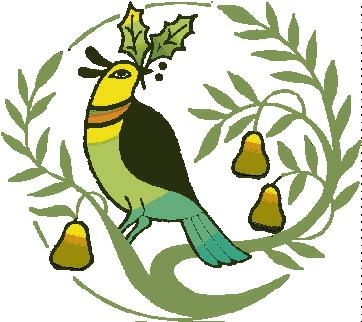
On the first day of Christmas, my true love gave to me, a partridge in a pear tree.

On the second day of Christmas, my true love gave to me, two turtle doves and a partridge in a pear tree.

On the third day of Christmas, my true love gave to me, three french hens, two turtle doves, and a partridge in a pear tree.

On the fourth day of Christmas, my true love gave to me, four calling birds, three french hens, two turtle doves, and a partridge in a pear tree.

On the fifth day of Christmas, my true love gave to me, five golden rings, four calling birds, three french hens, two turtle doves, and a partridge in a pear tree.

On the sixth day of Christmas, my true love gave to me, six geese-a-laying, five golden rings, four calling birds, three french hens, two turtle doves, and a partridge in a pear tree.

On the seventh day of Christmas, my true love gave to me, seven swans-a-swimming, six geese-a-laying, five golden rings, four calling birds, three french hens, two turtle doves, and a partridge in a pear tree.

On the eighth day of Christmas, my true love gave to me, eight maids-a-milking, seven swans-a-swimming, six geese-a-laying, five golden rings, four calling birds, three french hens, two turtle doves, and a partridge in a pear tree.

On the ninth day of Christmas, my true love gave to me, nine ladies dancing, eight maids-a-milking, seven swans-a-swimming, six geese-a-laying, five golden rings, four calling birds, three french hens, two turtle doves, and a partridge in a pear tree.

On the tenth day of Christmas, my true love gave to me, ten lords-a-leaping, nine ladies dancing, eight maids-a-milking, seven swans-a-swimming, six geese-a-laying, five golden rings, four calling birds, three french hens, two turtle doves, and a partridge in a pear tree.

On the eleventh day of Christmas, my true love gave to me, eleven pipers piping, ten lords-a-leaping, nine ladies dancing, eight maids-a-milking, seven swans-a-swimming, six geese-a-laying, five golden rings, four calling birds, three french hens, two turtle doves, and a partridge in a pear tree.

On the twelfth day of Christmas, my true love gave to me, twelve drummers drumming, eleven pipers piping, ten lords-a-leaping, nine ladies dancing, eight maids-a-milking, seven swans-a-swimming, six geese-a-laying, five golden rings, four calling birds, three french hens, two turtle doves, and a partridge in a pear tree.

The Carol's Meaning

  • My true love = God
  • Me = every baptized person, the Church
  • A Partridge in a pear tree = The Word made flesh, Jesus Christ (The portrayal of Christ as a mother partridge is inspired by his lament: "Jerusalem! Jerusalem! How often would I have sheltered thee under my wings, as a hen does her chicks, but thou wouldst not have it so...").

The pear tree signifies the wood of the manger (and also of the cross), while the fruit reminds us of the reason for the Incarnation: God's desire to save us from the sin introduced by Adam's and Eve's consumption of the fruit from the Tree of the Knowledge of good and evil. The fruit also reminds us of the Tree of Life in the midst of the Garden.

  • Two Turtle Doves = The two parts of the Sacred Scriptures [Old and New Testaments]
  • Three French Hens = The three theological virtues, given from God and poured into our hearts [Faith, Hope, and Charity]
  • Four Calling Birds = the four Gospels/Evangelists [Matthew, Mark, Luke, and John]
  • Five Golden Rings = The first five Books of the Old Testament, the "Pentateuch" [Genesis, Exodus, Numbers, Leviticus, and Deuteronomy]
  • Six Geese a-Laying = The six days of creation

1st Day: Creation of light and its separation from darkness

2nd Day: Creation of the firmament and division of the waters

3rd Day: Collection of waters (sea) and formation of dry land (earth); creation of plants according to their own likeness

4th Day: Creation of heavenly bodies in the firmament (sun, moon, and stars)

5th Day: Creation of sea creatures and winged fowl from the waters

6th Day: Creation of cattle, creeping things, and beasts from the dry land; creation of mankind, male and female

  • Seven Swans a-Swimming = the seven gifts of the Holy Spirit
    1. wisdom
    2. understanding
    3. counsel
    4. fortitude
    5. knowledge
    6. piety
    7. fear of the Lord

Also, the seven sacraments of the Catholic faith [Baptism, Confirmation, Holy Eucharist, Penance, Extreme Unction, Holy Orders, and Matrimony]

  • Eight Maids a-Milking = the eight Beatitudes [Mt. 5.3-12]
    1. Blessed are the poor in spirit: for theirs is the kingdom of heaven.
    2. Blessed are the meek: for they shall possess the land.
    3. Blessed are they that mourn: for they shall be comforted.
    4. Blessed are they that hunger and thirst after justice: for they shall have their fill.
    5. Blessed are the merciful: for they shall obtain mercy.
    6. Blessed are the clean of heart: they shall see God.
    7. Blessed are the peacemakers: for they shall be called the children of God.
    8. Blessed are they that suffer persecution for justice' sake: for theirs is the kingdom of heaven.
  • Nine Ladies Dancing = the nine choirs of angels (in ascending order)

1. Angels

2. Archangels

3. Principalities

4. Powers

5. Virtues

6. Dominations

7. Thrones

8. Cherubim

9. Seraphim

  • Ten Lords a-Leaping = the Ten Commandments

1. I am the Lord thy God; thou shalt not have strange gods before me.

2. Thou shalt not take the name of the Lord thy God in vain.

3. Remember that thou keep holy the Sabbath day.

4. Honor thy father and mother.

5. Thou shalt not kill.

6. Thou shalt not commit adultery.

7. Thou shalt not steal.

8. Thou shalt not bear false witness against thy neighbor.

9. Thou shalt not covet thy neighbor's wife.

10. Thou shalt not covet thy neighbor's goods.

  • Eleven Pipers Piping = the eleven faithful apostles [Simon Peter, James the Great, John, Simon (the Zealot), Jude (a.k.a. Thaddeus), Andrew, James the Less, Matthew, Phillip, Bartholomew, and Thomas]
  • Twelve Drummers Drumming = the twelve articles of the Apostle's Creed

1. I believe in God, the Father almighty, Creator of Heaven and earth;

2. And in Jesus Christ His only Son our Lord:

3. Who was conceived by the Holy Spirit, born of the Virgin Mary,

4. Suffered under Pontius Pilate, was crucified, died, and was buried.

5. He descended into Hell; on the third day He rose from the dead.

6. He ascended into Heaven, sitteth at the right hand of God the Father almighty;

7. From thence He shall come to judge the living and the dead.

8. I believe in the Holy Spirit,

9. The Holy Catholic Church, the Communion of Saints,

10. The forgiveness of sins,

11. The resurrection of the body,

12. And life everlasting. Amen.

The "Twelve Days of Christmas" is still an excellent expression of joy in the Incarnate Lord and a well-rounded summary of the life of Faith. And, by giving us something on which to meditate for each day, it is also an ideal way to spend the twelve days of Christmas. It even reminds us (by virtue of its history) of the cost many generations had to pay in order for us to receive the Good News we celebrate during this holy season.

7. The Twelve Days of Christmas

But what exactly are the Twelve Days of Christmas? They are the days between Christmas and the Feast of the Epiphany that constitute an unbroken period of joy and celebration (see Christmas Schema). Epiphany is considered the twelfth day of Christmas (in fact it is sometimes called "Twelfth Day") while the Eve of Epiphany is called "Twelfth Night." Shakespeare's play, "Twelfth Night," takes its name from the Vigil because during this period festivals (such as the Feast of Fools or the Feast of the Ass) used to be held in which everything was turned upside-down -- a little like the reversed identities of the characters in the play. These "preposterous" observances, incidentally, were a joyful mimicry of the inversion of almighty God becoming a lowly man, of the King appearing as a humble infant.

The twelve nights of Christmas were primarily a time of rest from unnecessary labor and joyful prayer. On each of these nights the Christmas tree lights and the Christmas candle would be lit, while the family would gather around the manger to recite prayers and sing carols and hymns. Similar services are held in some churches during these nights as well.

Several saints' days which fall within the Octave of Christmas are also a part of the Twelve Days. This might seem odd, but their placement is deliberate. By placing their feasts near the birth of the Lord, the Church is suggesting that there is a special spiritual proximity as well. St. Stephen (December 26) is the "Proto-Martyr," the first disciple of our Lord to be martyred. St. John (December 27) is the "beloved disciple" who rested on our Lord's bosom during the Last Supper. And the Holy Innocents (December 28) are obviously connected in a special way to our Lord's infancy. These saints are called the comites Christi, "the companions of Christ," and as that name implies, they are not only close to Him, but they have a certain nobility (the word comes, from which we get our word "count," also implies aristocracy). It is for these reasons, incidentally, that the Eastern churches honor the Princes of the Apostles, Peter and Paul, on December 28.

St. Thomas Beckett (December 29), the Archbishop of Canterbury who was killed by the king's men in 1170 on this day, would have normally seen his feast transferred to a date outside the Octave of Christmas. However, because his martyrdom was such a shock and outrage to Christendom, the Roman authorities deemed it appropriate to leave his "spiritual birthday" exactly where it was, thereby adding him to the list of Christ's nobility.

The final comes Christi is St. Sylvester I (December 31), the great pope who lived to see the Roman persecutions of the Church finally end during the reign of Emperor Constantine. It is therefore appropriate to honor this saint within the Octave that celebrates "peace on earth," especially on the day before the new civic year.

Listed below are some of the customs observed within the Twelve Days of Christmas.

8. St. Stephen's Day (December 26)

Though there is no historical connection, St. Stephen is considered the patron saint of horses. Scholars speculate that this has something to do with the relief from work that domestic animal enjoyed during Twelfth-night; in any case, horse parades or horse races were always held on this day. One custom in rural areas was for the horses to be decorated and taken to the church, where the priest would bless them. Afterwards, they would be ridden around the church three times. Horse's food (hay or oats) is also blessed on this day.

NOTA BENE: In the eleventh century, the Church instituted special feast days during the Christmas Octave for various ecclesiastical ranks. Today, on the day in which one of the first seven deacons was martyred, was the festival for deacons.

9. St. John's Day (December 27)

Saint John was the only Apostle who did not suffer martyrdom, though several attempts were made on his life. One of these involved giving him a glass of wine that had been poisoned. The saint, however, suffered no harm because he blessed it before he drank. It is in honor of this deliverance that the blessing and drinking of wine on St. John's Day was once a popular custom (see Foods). People had a bottle of wine blessed after the Saint's Mass and then drank it at the family dinner (notice how easily this can still be done). The special blessing for this occasion from the Roman ritual sums up the meaning of this custom:

O Lord God, deign to bless and consecrate with Thy right hand this cup of wine and of whatever drink: and grant that through the merits of Saint John, Apostle and Evangelist, all who believe in Thee and who drink from this cup may be blessed and protected. And as blessed John drank from the cup of poison and remained completely unharmed, may, through his merits, all who drink from the cup on this day in honor of blessed John be rescued from every sickness of poison and from every kind of harm; and, offering themselves up body and soul, may they delivered from all fault. Through Christ our Lord. Amen.

Bless, O Lord, this creature of drink: that it may be a remedy of salvation for all who consume it: and grant through the invocation of Thy holy name that whoever will have tasted of it may, through Thy giving, experience health of the soul as well as of the body. Through Christ our Lord. Amen.

And the blessing of almighty God, Father, Son, and Holy Spirit, descend upon this creature of wine and of whatever drink, and remain forever. Amen.

Today, on the day honoring the disciple who lay closest to Christ the High Priest during the first Mass, was the festival for priests (see above).

10. Feast of the Holy Innocents (December 28)

In many religious communities, Innocents' Day was the traditional feast for the youngest members. In keeping with the upside-down spirit of Twelfth-night, the youngest novice had the privilege of sitting at the first place or even of being abbot for a day. Baby food (see Foods) would be served to them.

In the family, the youngest member is also the "celebrity" of the day, especially if he is a baby. Customs like decorating the crib or blessing the baby are appropriate ways of observing the feast.

Today, on the day in which little ones shed their blood for Christ, was the festival for choirboys and students (see above).

11. St. Sylvester's Day (December 31)

The day that celebrates the first pope to enjoy civic peace is appropriately marked by family customs petitioning peace for the new year. On New Year's Eve it was traditional in France and other countries for the father to bless all members of the family, and for the children to thank their parents for all of their love and care. In Spain, it was considered good luck to eat twelve grapes at the twelve strokes of midnight. Services thanking God for the blessings of the year and seeking blessings for the new one were not uncommon, and neither were special Sylvester treats (see Foods).

12. Feast of the Circumcision and the Octave of the Nativity (January 1)

The Feast of the Circumcision combines celebrates many things. On the one hand, the feast celebrates the Octave of the Nativity and the Motherhood of the Blessed Virgin Mary (partially because the pope celebrated Mass in St. Mary Major on this day). On the other hand, it commemorates the Circumcision of our Lord which, though a cause of joy, is the cause of a more subdued kind of joy because it involves the shedding of our Lord's blood. There is also a tradition in the Roman church of penitence as a counterpoint to the pagan reveling of the day (a counterpoint which is necessary as much today as it was then). The Church delicately balances all of these elements in a single feast to God.

As mentioned above, it is traditional in France for adults to exchange gifts on this day. This custom is known as les étrennes.

Today, on the day in which St. Joseph circumcised our Lord (thereby consecrating him for God's holy service), was the festival for subdeacons (see above).

13. The Feast of the Holy Name of Jesus

Devotion to the Holy Name of Jesus was originally reserved to the Feast of the Circumcision, since it was at His circumcision that our Lord received His name. But because of the growth of this devotion, a separate feast was instituted, first by the Franciscans in the seventeenth century, then by the universal Church (its date was permanently fixed by Pope St. Pius X). One of the most cherished customs of this feast is singing the hymn, Jesu, Dulcis Memoria by St. Bernard of Clairvaux, the great medieval monk and tireless promoter of devotion to the Holy Name. The Litany of the Most Holy Name of Jesus, recited either after Mass or in procession, is also a popular devotion.


Epiphany Customs

X

1. The Holy Light of the Manifestations | 2. The Three Kings

3. Blessing of Water | 4. Magi Plays | 5. Feasting

6. Feast of the Holy Family

1. Epiphany: the Holy Light of the Manifestations (January 6)

Epiphany is one of the greatest feasts of the liturgical year. The twelfth day after Christmas, it concludes Christmastide proper by celebrating the "manifestation," or epiphaneia, of Christ to the Gentiles. Epiphany is in fact a holy day of obligation, though the United States has long had a dispensation from Rome that frees it from this duty. To this day the Eastern churches consider Epiphany more important than Christmas.

Epiphany first and foremost commemorates the Visitation of the Magi to the Christ Child in Bethlehem. The Holy Spirit's guidance of these wise men to the Holy Land through the aid of a star signifies the calling of all nations, not just the Jews, to the New Covenant. But this "manifestation" to non-Jews also calls to mind other manifestations of our Lord's divinity. The Nativity continues to be remembered as the first crucial manifestation, but so too does the Baptism of our Lord in the Jordan, since it affirms both His divinity as well as His humanity. And the wedding of Cana comes to mind because it was Christ's first public manifestation of His power with the transubstantiation of water into wine. (It also comes to mind because the Gospel uses the word "manifest" (ephanerosen) to describe this event (Jn. 2.11).) Finally, the manifestations of Jesus Christ during His earthly existence ineluctably lead us to consider His final manifestation in glory, a manifestation for which we have longed throughout Advent and Christmastide. Hence St. John Chrysostom says in his sermon on Epiphany:

There are two manifestations of Christ, not one. The first is the one which has already happened, His epiphany in the present. The second is the one of the future which will come at the end of time with great splendor and glory. You have heard read today what St. Paul writes to Titus about both of these epiphanies. Concerning the first he says, "The grace of God our Savior has appeared to all men..." About the second he writes, "We look for the blessed hope and glorious coming of our great God and Savior, Jesus Christ" (Titus 2.11-13) (On the Baptism of Christ).

It is for these reasons that St. Gregory Nazianzus refers to Epiphany as the "the Holy light of the manifestations."

2. The Three Kings

The Gospel of Matthew mentions only that several Magi -- respected priestly scholars from Persia and other neighboring countries -- came to worship the Christ Child from the East. Tradition, however, has added a few details: that there were three of them, that they were kings, and that their names were Gaspar, Melchior, and Baltasar. Devotion to the three kings is a marked feature of Epiphany and was traditionally encouraged in a number of ways. From Christmas onward, for example, the figurines of the Magi, which had been kept a distance from the crèche, were brought closer and closer until it reached the crèche on Twelfth-night. Another traditional observance was the solemn blessing of a home on the Feast of the Epiphany, after which the initials of the Magi would be written on the frame of the door, together with the year and several crosses that connected all of the letters and numbers. There is even a special blessing for the chalk in the Roman ritual.

3. Blessing of Water

The commemoration of our Lord's Baptism in the Jordan led to a number of impressive blessings concerning water. In Palestine, the river Jordan itself was blessed, with throngs of the faithful immersing in it three times to obtain the blessing, while in Egypt, the whole Christian population and its livestock would show up for the blessing of the Nile and do the same thing. In Byzantium, Epiphany water was blessed in church and then distributed. Rome followed this custom, instituting it on the Vigil of the feast. The formula for the blessing may be found in the Roman ritual.

4. Magi Plays

Like Christmas, Epiphany was a favorite time for caroling; and like all great solemnities from the Middle Ages, Epiphany encouraged mystery plays. These were called Magi plays and featured

the story of the Nativity, the slaughter of the Innocents, and the visit of the Magi. They were also quite boisterous: the character of Herod was portrayed as a raving lunatic, wreaking havoc with his wooden spear: hence Shakespeare's line about overacting-- "it out-herods Herod!" (Hamlet III.ii). Variations of these mystery plays have survived into the present day.

5. Feasting

And also like all great solemnities, Epiphany was a day for great feasting. Though the dishes varied, one consistently popular customs was Kings' or Twelfth-night cake, which included a small object that identified its finder as the "king" for the day (see Foods). Many countries also use this occasion for the exchange of gifts (see above).

6. The Feast of the Holy Family

Held on the Sunday after Epiphany, the Feast of the Holy Family of Jesus, Mary, and Joseph holds up the domestic life of Jesus, his mother, and foster father as the perfect model for all Catholic households. As Pope Leo XIII explains, there is a lesson in this family for everyone: for fathers, for mothers, for children; for nobility (the Holy Family was from the royal house of David), for the poor (they gave up their possessions in fleeing to Egypt), and so on. There are no prescribed or uniform customs for the feast, but that does not mean no observances were made. The following is an account from Father Weiser of Holy Family Sundays at our own parish, Holy Trinity German Church, in the 1940s.

The annual Holy Childhood procession, on the feast of the Holy Family, is one of the most attractive ceremonies. In former years this procession was called the "Shepherds' Procession" as the children marched through the church dressed as shepherds and shepherdesses -- a lovely relic of popular medieval piety (Holy Trinity Parish, 1844-1944, p. 37).

This feast is also an ideal time to pray any of the devotions to the Holy Family that are given in the Raccolta, the Church's old official list of indulgences. The fact that many of these prayers are no longer indulgenced does not make them any less meaningful or worthy of use.

The Meaning of Christmastide

Christmastide Schema | Christmastide Foods

The Liturgical Year

Parish Home Page | Latin Mass Home Page


ORIGIN OF
"THE TWELVE DAYS OF CHRISTMAS"

An Underground Catechism

You're all familiar with the Christmas song, "The Twelve Days of Christmas" I think. To most it's a delightful nonsense rhyme set to music. But it had a quite serious purpose when it was written.

It is a good deal more than just a repetitious melody with pretty phrases and a list of strange gifts.

Catholics in England during the period 1558 to 1829, when Parliament finally emancipated Catholics in England, were prohibited from ANY practice of their faith by law - private OR public. It was a crime to BE a Catholic.

"The Twelve Days of Christmas" was written in England as one of the "catechism songs" to help young Catholics learn the tenets of their faith - a memory aid, when to be caught with anything in *writing* indicating adherence to the Catholic faith could not only get you imprisoned, it could get you hanged, or shortened by a head - or hanged, drawn and quartered, a rather peculiar and ghastly punishment I'm not aware was ever practiced anywhere else. Hanging, drawing and quartering involved hanging a person by the neck until they had almost, but not quite, suffocated to death; then the party was taken down from the gallows, and disembowelled while still alive; and while the entrails were still lying on the street, where the executioners stomped all over them, the victim was tied to four large farm horses, and literally torn into five parts - one to each limb and the remaining torso.

The songs gifts are hidden meanings to the teachings of the faith. The "true love" mentioned in the song doesn't refer to an earthly suitor, it refers to God Himself. The "me" who receives the presents refers to every baptized person. The partridge in a pear tree is Jesus Christ, the Son of God. In the song, Christ is symbolically presented as a mother partridge which feigns injury to decoy predators from her helpless nestlings, much in memory of the expression of Christ's sadness over the fate of Jerusalem: "Jerusalem! Jerusalem! How often would I have sheltered thee under my wings, as a hen does her chicks, but thou wouldst not have it so..."

The other symbols mean the following:

2 Turtle Doves = The Old and New Testaments
3 French Hens = Faith, Hope and Charity, the Theological Virtues
4 Calling Birds = the Four Gospels and/or the Four Evangelists
5 Golden Rings = The first Five Books of the Old Testament, the "Pentateuch", which gives the history of man's fall from grace.
6 Geese A-laying = the six days of creation
7 Swans A-swimming = the seven gifts of the Holy Spirit, the seven sacraments
8 Maids A-milking = the eight beatitudes
9 Ladies Dancing = the nine Fruits of the Holy Spirit
10 Lords A-leaping = the ten commandments
11 Pipers Piping = the eleven faithful apostles
12 Drummers Drumming = the twelve points of doctrine in the Apostle's Creed

--Fr. Hal Stockert 12/17/95

P.S. It has come to our attention that this tale is made up of both fact and fiction. Hopefully it will be accepted in the spirit it was written. As an encouragement to people to keep their faith alive, when it is easy, and when any outward expressions of their faith could mean their life. Today there are still people living under similar conditions, may this tale give them courage, and determination to use any creative means at their disposal to keep their faith alive.
Courtesy of Catholic Information Network (CIN)

How do you plan to celebrate Advent and The Christmas Season?